

How much do photographers really earn in 2026?
The honest answer is that there is no single worldwide photographer salary. A staff photographer in Canada, a wedding photographer in Morocco, a commercial studio in England and a stock contributor selling internationally are not earning through the same system.
Some photographers receive an hourly wage or annual salary. Others invoice clients, license images, sell prints, create digital products, teach workshops or earn commissions from content. Many combine several of these models.
That makes one distinction essential:
Salary is not the same as freelance revenue. Revenue is not the same as business profit. Business profit is not the same as personal take-home pay.
This global guide explains:
- How to scale income without relying on unrealistic promises
- What selected official country data says—and what it cannot tell you
- How to research photographer earnings in your own country
- The monetization methods photographers actually use
- The tools and platforms needed to operate professionally
- How to calculate real earnings in your local currency
Table of Contents
How Much Do Photographers Make? It Depends on the Earning Model
A photographer’s income is shaped by five factors:
- Country and local market: Prices, wages, taxes, purchasing power and demand differ by location.
- Employment model: Employees receive wages or salaries; independent photographers operate businesses.
- Specialization: Portraits, weddings, property, products, commercial campaigns, news, fine art and licensing have different economics.
- Capacity and demand: A high session price means little if bookings are rare or delivery takes too many hours.
- Income mix: Services, retainers, licensing, products, education and content behave differently.
The most useful question is therefore not only, “What do photographers earn?” It is:
Which earning model am I measuring, in which market, during which period, and after which costs?
Global Photographer Earnings: Selected Official Reference Points
The figures below are not a ranking of countries. They use different currencies, reference periods, worker populations and statistical methods. A photographer salary by country comparison provides useful context only when those differences are kept visible. Do not convert every figure into one currency and assume that the highest converted number represents the best market.
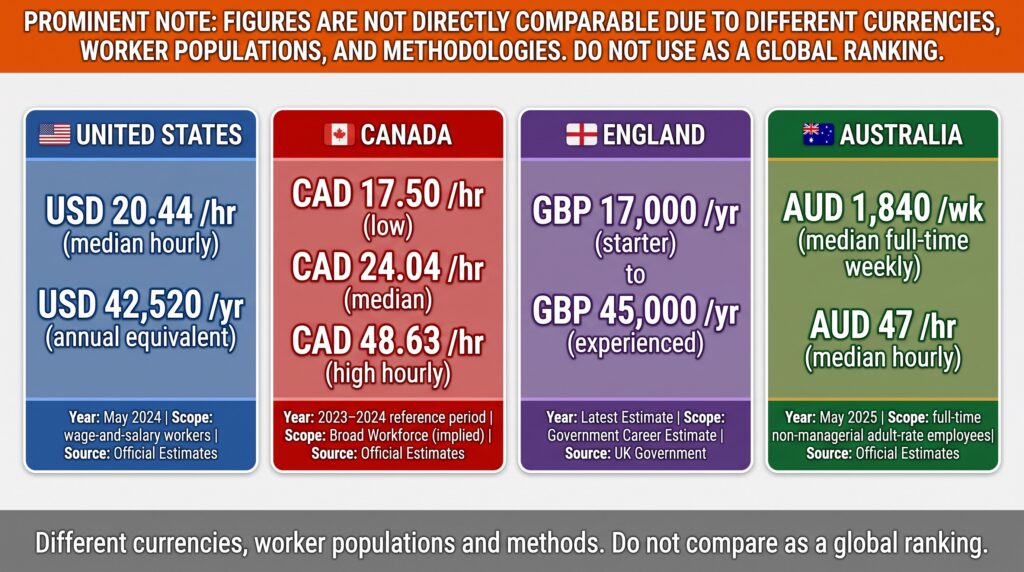
The figures below are not a ranking of countries. They use different currencies, reference periods, worker populations and statistical methods. Do not convert them into one currency and assume that the highest converted number represents the best market.
| Market and official source | Published reference point | What it measures | Important limitation |
|---|---|---|---|
| United States — U.S. Bureau of Labor Statistics | USD 20.44 median hourly wage; USD 42,520 annual equivalent, May 2024 | Wage-and-salary photographer employment | The wage survey excludes self-employed workers, so it does not measure freelance revenue or business profit. |
| Canada — Government of Canada Job Bank | CAD 17.50 low, CAD 24.04 median and CAD 48.63 high per hour; 2023–2024 reference period | National hourly wage observations for photographers | Regional results vary, and hourly wages are not the same as self-employed project revenue. |
| England — National Careers Service | GBP 17,000 starter to GBP 45,000 experienced; typical hours listed as 39–41 and variable | Government career-profile estimate | This is a broad career range, not a directly comparable national wage distribution. |
| Australia — Jobs and Skills Australia | AUD 1,840 median full-time weekly earnings and AUD 47 median hourly earnings; May 2025 | Full-time non-managerial employees paid at the adult rate | The occupation also has a 47% part-time share, and the earnings data does not represent every photographer or business owner. |
Sources: U.S. Bureau of Labor Statistics, Government of Canada Job Bank, England’s National Careers Service and Jobs and Skills Australia.
What about Europe, Africa, Asia, Latin America and the Middle East?
There is no current, harmonized worldwide photographer-income number that responsibly represents every region.
Readers in other countries should begin with:
- Their national statistics office
- Their labour ministry or government career service
- A recognized occupational wage database
- ILOSTAT earnings data
- Eurostat earnings by occupation for participating European datasets
- Local professional-photography associations
- Real local quotations, job advertisements and client interviews
A missing official photographer figure does not justify using an unsourced blog estimate. Use the closest transparent source, state exactly what it measures and explain its limitations.
Why Country Salary Comparisons Can Mislead
Currency conversion does not equal purchasing power
Converting every figure to U.S. dollars ignores housing, transport, insurance, software, equipment-import costs, taxes and local client budgets.
Employee data may exclude most independent photographers
In the United States, BLS reports that 66% of photographers were self-employed in 2024, while its wage statistics exclude self-employed workers. That makes the official wage useful—but incomplete.
Annual figures may hide part-time and seasonal work
Photography can include evening, weekend, seasonal and irregular schedules. A weekly or annual number does not reveal the number of hours worked or months with low demand.
“Photographer” may combine very different jobs
A staff photojournalist, school photographer, e-commerce studio employee and freelance wedding photographer may all appear under the same broad occupation.
Freelance invoices include business costs
An independent photographer may collect more revenue than an employee’s salary while keeping less after assistants, travel, editing, equipment, software, studio costs, marketing, payment fees and taxes.
Salary, Revenue, Profit and Take-Home Pay
Salary or wage
Money paid by an employer before personal taxes and deductions. Benefits may or may not be included.
Collected business revenue
Money the photography business actually receives from clients, licensing, product sales or platforms during the period.
Do not count an unpaid invoice as collected revenue.
Business profit
What remains after legitimate business expenses are deducted from collected revenue.
Estimated business profit = collected revenue − direct job costs − operating overhead
Effective hourly return
The return generated for every hour spent operating the business.
Effective hourly return = estimated business profit ÷ total business hours worked
Include:
Marketing and prospecting
Calls and client communication
Planning and travel
Shooting
Culling and editing
Delivery and revisions
Bookkeeping and administration
Product creation and customer support
Personal take-home pay
What the owner can personally use after the business result, applicable taxes, social contributions and any other local obligations. Rules vary by country and business structure. Readers should use a qualified local accountant or tax authority for personal tax decisions.
How to Research Photographer Earnings in Your Country
Step 1: Identify the earning model
Decide whether you need data for:
An employee job
Freelance client services
A photography business
Licensing and stock
Digital products
Education and content
A mixture of several models
Step 2: Find the most authoritative local source
Prioritize government labour statistics, official career services and recognized professional bodies. Record the source URL and access date.
Step 3: Check the definition
Ask:
Does the figure include self-employed photographers?
Is it hourly, weekly, monthly or annual?
Is it gross or net?
Is it full-time only?
Which year does it represent?
Does it cover the entire country or one region?
Is it a median, average, range or anecdotal estimate?
Step 4: Compare local market evidence
For freelance work, collect real evidence:
Ten relevant local competitors
Ten client conversations or enquiries
Current job advertisements
Local studio, transport and assistant costs
Common turnaround expectations
Typical usage and licensing needs
Do not copy a competitor’s price without understanding their deliverables, experience, costs and customer.
Step 5: Build your own numbers
Use your local currency and track actual collected revenue, costs, hours, enquiries, bookings and repeat customers. Your records will eventually become more useful than a general salary article.
Step-by-Step Monetization Methods Photographers Use
Photographers do not all follow the same ladder. These photography income streams can be combined, but beginners should validate one clear offer before adding several complicated methods.
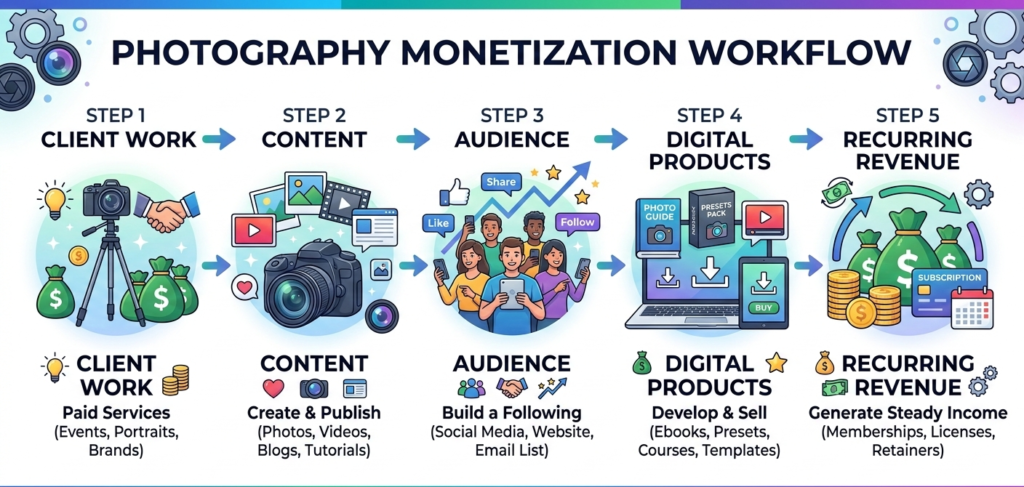
Step 1: Start With a Focused Client Service
Client work is often the most direct path to a first payment because one customer pays for a defined result.
Possible offers include:
Portrait and family sessions
Corporate headshots
Weddings and events
Product photography
Property and interior photography
Restaurant and hospitality content
School, sports or community photography
How to start:
Choose one customer group you can reach.
Define the deliverables, turnaround, revision limit and usage terms.
Build a small portfolio for that exact problem.
Calculate all production and delivery hours.
Contact potential clients or referral partners consistently.
Track enquiries, proposals, bookings and profit per job.
Income measure: Bookings × average collected value − direct costs − allocated overhead.
Step 2: Productize the Service
A productized service is easier to understand and deliver than an open-ended promise to “take photos.”
A clear package may state:
Who it is for
What is included
Where the shoot takes place
Approximate production time
Number or type of delivered assets
Turnaround
Revision policy
Usage rights
Optional add-ons
Productizing does not mean every client receives identical work. It means the sales and delivery process is controlled enough to estimate time, cost and margin.
Step 3: Add Repeat Business and Retainers
Predictable revenue can be more valuable than constantly searching for new one-off projects.
Possible repeat arrangements include:
Monthly content for restaurants or hotels
Recurring e-commerce product batches
New-employee headshot days
Property listings for agencies
Seasonal campaigns
School or sports coverage
Ongoing editing or asset-management support
How to start:
Identify a client need that genuinely repeats.
Define monthly production days or deliverables.
Set boundaries for revisions, travel and unused capacity.
Review the agreement after an initial test period.
Track client concentration so one account does not control the business.
Income measure: Active recurring clients × monthly collected amount − recurring delivery costs.
Step 4: License Images Directly or Through Stock Platforms
Licensing allows a photographer to grant defined usage rights without transferring unlimited ownership by default.
Routes include:
Direct licensing to publishers, brands and organizations
Editorial licensing
Stock marketplaces
Archive licensing
Local tourism, nature or cultural collections
Platforms such as Adobe Stock, Shutterstock Contributor and Alamy Contributors provide distribution, but acceptance rules, royalties, payout methods and licensing terms can change.
Adobe’s official contributor guide currently states a 33% royalty for photos, vectors and illustrations under standard plans, while Shutterstock uses its own contributor earnings and payment system. Check current official terms before choosing a platform.
Income measure: Number of paid licenses × average net royalty or licensing fee.
Stock is not automatically passive. Research, releases, metadata, keywording, uploading and portfolio maintenance require work.
Step 5: Sell Prints, Albums and Physical Products
Physical products can raise the value of portrait, wedding, landscape, wildlife and fine-art work.
Possible products include:
Prints
Albums
Framed wall art
Calendars
Postcards
Limited editions
Client gift products
Calculate lab cost, packaging, damage, shipping, returns, taxes and customer service. A high selling price does not guarantee a strong margin.
Income measure: Units sold × net contribution per unit.
Step 6: Offer Editing, Retouching or Production Support
Some photographers earn by supporting other photographers, agencies and brands.
Offers may include:
Culling
Color correction
Portrait retouching
Product cleanup
Real-estate editing
Album design
File organization and delivery
Short-form video edits
This model can work remotely, but the scope and quality standard must be explicit. Use test files, written instructions and a revision limit.
Step 7: Create Digital Products or Teach
A photographer can package a repeatable solution into:
Presets and profiles
Workflow templates
Posing guides
Shot lists
Client questionnaires
Contracts reviewed for the seller’s jurisdiction
Ebooks
Recorded courses
Live workshops
Portfolio reviews
Mentoring
Digital products are scalable only when people can discover and trust them. They also require demonstrations, instructions, updates, customer support and refund handling.
Marketplaces and storefront options include Etsy, WooCommerce, Gumroad and Payhip. Availability, payment methods, fees, taxes and seller rules vary by country.
Income measure: Units sold × net revenue per sale − product-development and support costs.
Step 8: Build Content, Affiliate and Sponsorship Revenue
Educational content can support:
Advertising
Affiliate commissions
Sponsorships
Product sales
Workshop sales
Client enquiries
Newsletter partnerships
Channels may include a website, YouTube, Pinterest, Instagram, TikTok, LinkedIn or an email newsletter.
Do not recommend products only because they pay a commission. Disclose commercial relationships according to the laws and platform rules that apply to you and your audience.
Income measure: Net platform revenue + affiliate commissions + sponsorship income + attributed product or service sales.
Content income normally requires an audience, search visibility or distribution. It should not be presented as instant passive income.
What Each Monetization Method Can Earn
A global article cannot responsibly assign one universal monthly amount to each model. Use the formulas below with your own market data.
| Income model | Calculation | Key constraint |
|---|---|---|
| One-off services | Bookings × average collected value | Lead flow, capacity and non-shooting hours |
| Retainers | Active clients × monthly collected amount | Delivery capacity and client concentration |
| Direct licensing | Licenses × average net licensing fee | Buyer relationships, rights and archive relevance |
| Stock platforms | Paid downloads × average net royalty | Portfolio usefulness, discovery and platform terms |
| Prints and products | Units × net contribution per unit | Production, shipping, returns and audience |
| Digital products | Units × net revenue per sale | Traffic, trust, support and marketplace fees |
| Education | Seats or sales × net amount per customer | Authority, curriculum quality and promotion |
| Content and affiliate | Platform + commission + attributed sales | Audience, disclosure, conversion and platform dependence |
After calculating revenue, subtract direct costs, overhead and the value of all working hours before comparing methods.
Which Photography Income Method Should You Start With?
| Your current advantage | Best first test | Why |
|---|---|---|
| Local network but small online audience | Focused local client service | Direct access to customers can produce evidence faster than waiting for online traffic. |
| Access to businesses | Product, hospitality, property or monthly content offer | Business needs may repeat and can be connected to a clear commercial outcome. |
| Large organized image archive | Direct licensing or carefully selected stock portfolio | Existing assets can be reviewed for real buyer use cases. |
| Strong editing skill | Retouching or post-production service | The service can be delivered remotely with a controlled workflow. |
| Teaching ability and proof of expertise | Workshop, review or narrow digital guide | A specific learning outcome is easier to sell than a generic course. |
| Existing audience or search traffic | Relevant affiliate content or digital product | Distribution already exists, but trust and disclosure remain essential. |
Tools & Platforms Needed to Make Real Money

Tools do not create demand. They reduce friction after you have a clear customer and offer.
Choose the smallest reliable system that can attract a lead, confirm the job, collect payment, produce the work, deliver it safely and measure the result.
| Business need | Possible tools or platforms | What to check |
|---|---|---|
| Portfolio and discovery | WordPress, Squarespace, Adobe Portfolio, Google Business Profile, relevant social platforms | Local visibility, page speed, ownership, mobile experience and search intent |
| Lead capture and CRM | Contact form, spreadsheet, Notion, HoneyBook, Dubsado, Studio Ninja | Country availability, automation needs, privacy and cost per booked client |
| Contracts and proposals | Locally appropriate contract templates, e-signature and proposal tools | Usage rights, cancellation, payment, revisions and local legal requirements |
| Invoices and payments | Local bank transfer, PayPal, Stripe, Wise or regional payment providers | Availability, currency conversion, withdrawal, chargeback, tax and transaction fees |
| Editing and production | Lightroom, Photoshop, Capture One, Affinity Photo, DaVinci Resolve | File compatibility, color workflow, hardware requirements and recurring cost |
| Client delivery | Pixieset, Pic-Time, SmugMug, secure cloud folders or a self-hosted portal | Download control, privacy, gallery expiry, storage and print options |
| Backup and archive | Local working drive, separate backup and an off-site or cloud copy | Recovery testing, upload speed, retention and data-location requirements |
| Stock and licensing | Adobe Stock, Shutterstock, Alamy and direct licensing | Acceptance rules, releases, royalties, exclusivity, payout and tax forms |
| Digital products | WooCommerce, Etsy, Gumroad, Payhip or another locally supported storefront | Payment availability, tax handling, fees, file delivery, refunds and customer ownership |
| Email and audience | MailerLite, Brevo, Kit or another compliant provider | Consent, unsubscribe process, data protection, automation and cost as the list grows |
| Measurement | Accounting records, lead tracker, platform dashboards, Google Search Console and analytics | Collected revenue, source of leads, conversion, cost, margin and repeat business |
Minimum operating stack for a beginner
You do not need every platform above. A practical starting stack is:
One focused portfolio or service page
One enquiry form
One lead tracker
One written agreement and invoice process
One locally available payment method
One editing workflow
One delivery method
A tested backup system
A basic income, cost and hours tracker
Add software only when it solves a measured bottleneck.
Free 30-Day Photography Monetization Experiment
The global earnings data shows what photographers may earn; this practical experiment helps readers test one real offer in their own market and currency.
Visible subscriber message: Enter your email below to unlock the complete 30-day action plan. You will choose one reachable customer, build one clear offer, contact the market and measure bookings, costs and effective hourly return.
Common Mistakes That Limit Photography Income
Using worldwide salary figures as personal forecasts
A country benchmark cannot predict an individual business result.
Confusing invoices with income
An invoice is not collected revenue, and collected revenue is not profit.
Pricing only the shooting time
Planning, travel, communication, editing, delivery and administration also consume capacity.
Copying a foreign price
A price from another country may reflect different purchasing power, costs, taxes, expectations and usage rights.
Buying equipment before validating demand
Gear can improve delivery, but it does not create a customer.
Depending on one platform
Algorithms, rules, payouts and account access can change. Build direct relationships, an owned website and an email list where appropriate.
Adding too many income streams too early
Several weak systems create complexity. Validate one reliable offer before expanding.
Treating licensing as unlimited ownership
Define duration, territory, media, exclusivity and permitted uses when relevant. Obtain locally appropriate legal advice for important contracts.
Ignoring currency and payment friction
International work can involve conversion fees, delayed withdrawals, withholding, platform restrictions and local tax obligations.
Scaling unprofitable work
More bookings do not help if each job consumes too much time or loses money.
Scaling Tips: How to Increase Photography Income

Scaling should improve profit, reliability or reach—not only gross revenue.
1. Improve conversion before increasing traffic
Track which enquiries become calls, proposals and bookings. Improve the offer, proof and response process before spending more on promotion.
2. Increase collected value through useful add-ons
Relevant add-ons may include additional images, faster delivery, albums, prints, video clips, multiple locations or broader commercial usage.
Do not add something merely to inflate the invoice. It should create value and have a controlled delivery cost.
3. Raise prices when the evidence supports it
Review prices when:
- Demand exceeds safe capacity
- Costs have increased
- Results and proof have improved
- The deliverable has expanded
- The market consistently accepts the current offer
- The business cannot maintain quality at the current margin
Do not promise a fixed percentage increase every six or twelve months. Use actual demand, costs, scope and conversion data.
4. Standardize the workflow
Create reusable:
- Enquiry replies
- Questionnaires
- Shot lists
- Lighting setups
- File structures
- Editing presets
- Delivery emails
- Backup procedures
Standardization reduces avoidable hours while protecting consistency.
5. Build repeat business
Follow up appropriately, deliver reliably and identify needs that recur. Retainers are useful only when the work genuinely repeats and the agreement protects capacity.
6. Strengthen referrals and partnerships
Potential partners include:
- Event planners
- Makeup artists
- Designers
- Agencies
- Printers
- Venues
- Real-estate professionals
- Tourism businesses
- Schools and sports organizations
Measure referral quality rather than collecting partnerships that produce no work.
7. Add a scalable product after learning from clients
Repeated client questions may reveal a useful template, guide, workshop, preset or training product. Build from proven demand instead of guessing.
8. Build an owned audience
A useful website and permission-based email list reduce dependence on one social platform. Publish material that answers the real questions of the customers or learners you want to reach.
9. Outsource only a proven process
Before outsourcing editing, administration or production:
- Document the workflow
- Define the quality standard
- Protect client data
- Calculate the cost
- Confirm that the saved capacity can produce more value
- Use appropriate agreements
10. Expand internationally carefully
International clients or digital products can expand reach, but check:
- Payment and withdrawal support
- Currency-conversion cost
- Taxes and invoicing rules
- Data-protection obligations
- Contract enforceability
- Shipping and returns
- Time zones and support expectations
11. Track the numbers that control income
At minimum, track:
- Qualified enquiries
- Booking rate
- Average collected value
- Direct cost per job
- Total hours per job
- Effective hourly return
- Repeat-customer rate
- Referral rate
- Revenue concentration by client
- Net results by income stream
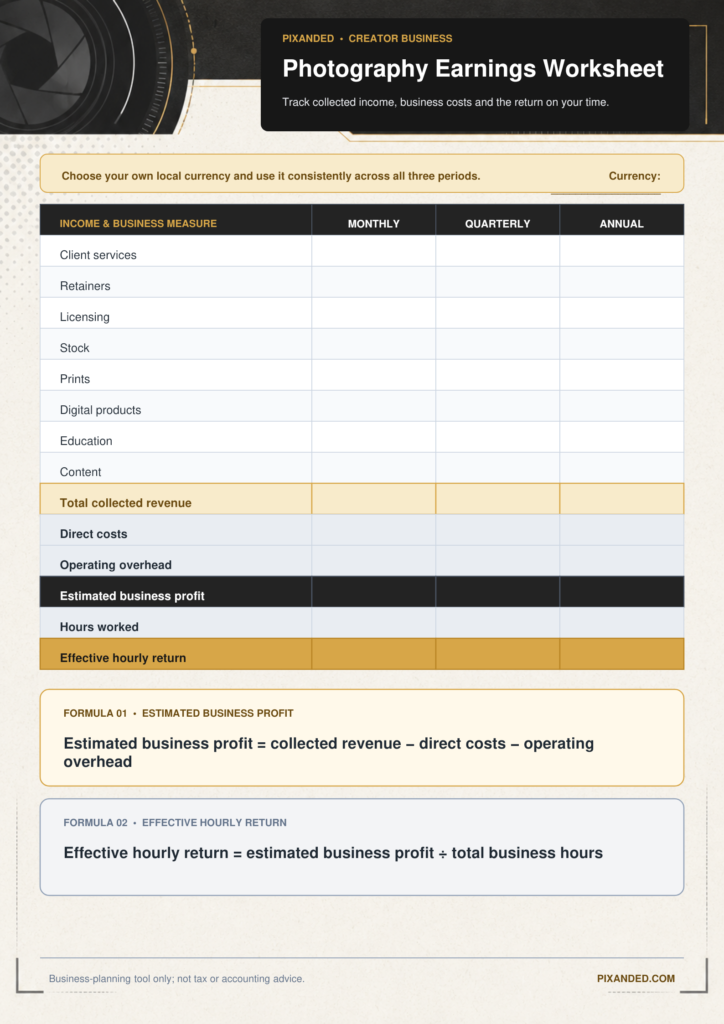
Local-Currency Photography Earnings Worksheet
Use one currency consistently for each reporting period.
| Line | Month | Quarter | Year |
|---|---|---|---|
| Collected client-service revenue | |||
| Collected retainer revenue | |||
| Licensing and stock payouts | |||
| Print and product revenue | |||
| Digital-product and education revenue | |||
| Content, affiliate and sponsorship revenue | |||
| Total collected revenue | |||
| Direct job and product costs | |||
| Allocated operating overhead | |||
| Estimated business profit before personal tax | |||
| Total business hours worked | |||
| Effective hourly return |
Estimated business profit = total collected revenue − direct costs − allocated overhead
Effective hourly return = estimated business profit ÷ total business hours
This worksheet is for business planning, not tax or accounting advice.
FAQs
How much do photographers really earn worldwide?
There is no trustworthy single worldwide number. Official sources use different currencies, worker definitions, periods and methods. Use selected country data as context, then calculate local employee wages or business results separately.
Which country pays photographers the most?
A converted salary table cannot answer this reliably. Purchasing power, taxes, living costs, benefits, hours, self-employment rates and market demand matter. Compare like with like using official local data.
Can freelance photographers earn more than salaried photographers?
They can collect more revenue, but they also pay business expenses and carry more risk. Compare employee compensation with freelance profit and effective hourly return—not with invoice totals.
How much can a beginner photographer earn?
There is no universal beginner range. Early results depend on local access, portfolio relevance, outreach, price, capacity and customer demand. A beginner should run a controlled market test and measure actual bookings and costs.
Which photography type earns the most?
No niche is universally best. Commercial, event, property, product, portrait, licensing, education and content models all have different demand, expenses and sales cycles. The best option is one with enough demand, a defendable result and workable margin in your market.
Can photographers earn six figures?
Some businesses can, but six-figure revenue does not mean six-figure profit or take-home pay. Location, currency, team size, expenses and income mix must be stated before the claim is meaningful.
Is stock photography passive income?
No. Licensing may create repeated sales, but research, production, releases, metadata, uploading, review and portfolio maintenance require work.
What platform is best for making money from photography?
The best platform is the one that reaches your buyer, supports your country and payment method, protects the required rights, and produces a positive net result. A local client may come from Google or referrals; licensing may require a stock marketplace; a digital product may need a storefront and email audience.
How long does it take to earn a full-time photography income?
There is no reliable global timeline. Existing skill, network, offer, local demand, sales ability, costs and available hours all change the result. Track leading indicators instead of relying on a generic two-to-four-year promise.
Final Takeaway
How much do photographers really earn in 2026?
The answer depends on where they work, whether they are employees or business owners, what they sell, how consistently they find buyers and what remains after costs and time.
Official wage data can provide a reference point. It cannot predict freelance revenue or profit. Client services can create a direct path to payment. Retainers can improve predictability. Licensing, products, education and content can expand reach, but each requires its own distribution and operating system.
Start with one customer and one clear offer. Measure collected revenue, every cost and every working hour. Add another income stream only when the first one is understood.
For the separate question of whether a photography business can be profitable, read Is Photography Still Profitable in 2026?.