

If you’ve been thinking about turning your passion for photography into a source of income, you’ve probably asked yourself one important question:
Is photography still profitable in 2026?
Short answer: Yes, photography can still be profitable in 2026—but profitability depends on the problem you solve, the market you serve, how consistently you find customers and how well you control your costs. Revenue alone is not profit.
Smartphones can produce excellent images, AI can generate visuals in seconds and online platforms have made photography more competitive. None of that means paid photography has disappeared. It means generic image-making is easier to replace, while work built around access, trust, direction, consistency, local knowledge and commercial results remains valuable.
The strongest photography businesses do not simply “take good pictures.” They create an offer for a specific customer, price it around the full workload and build a repeatable way to attract the next client or sale.
This guide explains what profitable photography actually means, where photographers can earn money in 2026 and how to test a business idea without relying on unrealistic income promises.
Table of Contents
What does “profitable photography” actually mean?
A photography activity becomes profitable when the money it brings in is greater than every cost required to produce and sell the work.
That includes obvious expenses such as travel, assistants, studio rental, printing and payment fees. It also includes less visible costs:
- Editing and delivery time
- Equipment maintenance and replacement
- Software and cloud storage
- Insurance and licenses
- Website, advertising and sales tools
- Client communication and administration
- Taxes and other obligations that apply in your location
- Time spent finding work that does not become a paid booking
A photographer can have strong revenue and still keep very little profit. That is why pricing should begin with the complete job, not only the time spent holding the camera.
A simple starting formula is:
Job contribution = client payment − direct job costs
Then calculate:
Estimated monthly profit = total job contributions − monthly business overhead
Finally, measure the return on your time:
Effective hourly return = estimated profit ÷ all hours worked
“All hours” should include preparation, travel, shooting, editing, delivery, revisions, marketing and administration.
What current employment data tells us and what it does not
The latest U.S. Bureau of Labor Statistics profile available during this revision reports that photographers held about 151,200 jobs in 2024. It also says 66% of photographers were self-employed and projects 2% employment growth from 2024 to 2034, with about 12,700 openings per year on average over the decade.
For wage-and-salary photographers, the reported May 2024 median was USD 20.44 per hour, or USD 42,520 per year.
These figures provide useful context, but they are not a promise of business income. The BLS Occupational Employment and Wage Statistics survey does not include self-employed workers, owners or partners in unincorporated firms. It also measures wages—not freelance revenue or net business profit.
The practical conclusion is more balanced than “photography is dead” or “anyone can earn six figures.” Paid demand still exists, but the result for an independent photographer depends heavily on location, niche, costs, sales ability and repeat business.
Sources: U.S. Bureau of Labor Statistics—Photographers and OEWS scope and exclusions.
Why people still pay photographers in 2026
Clients do not only pay for camera ownership. They may pay for:
- Access to a real person, place, property or event
- Lighting, posing and direction
- Consistent images across a campaign or catalogue
- Reliable capture when a moment cannot be repeated
- Fast delivery and an organized workflow
- Accurate color and product presentation
- Usage rights and clear licensing
- Privacy, trust and professional conduct
- Images designed to achieve a business goal
These advantages are strongest when the photographer understands the customer’s outcome. A restaurant needs images that help sell food. A real-estate agent needs a consistent listing workflow. A company needs credible headshots delivered on schedule. A family wants important moments preserved without managing the process themselves.
15 realistic ways to make money with photography
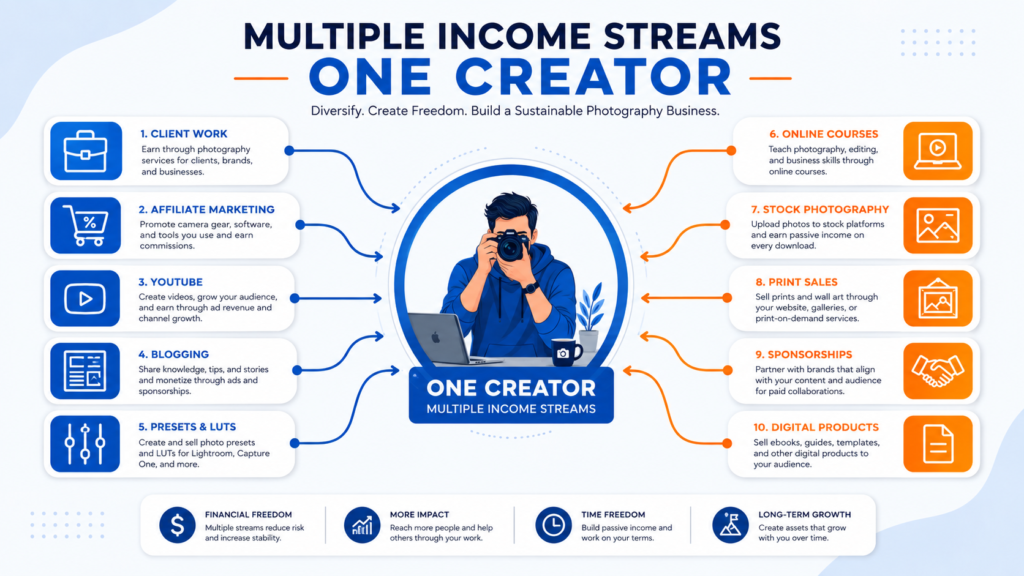
1. Portrait and family photography
Portrait sessions can be one of the most direct ways to earn because the customer and deliverable are easy to understand. A focused offer—such as family portraits, graduation sessions or personal branding—is usually easier to market than a general “I photograph everything” service.
Profit depends on controlling travel, shooting, editing and revision time. Packages should clearly state the session length, number of delivered images, turnaround time and usage terms.
2. Wedding and event photography
Weddings, celebrations, conferences and corporate events require reliable real-world coverage that cannot be recreated later. The work can support higher-value bookings, but it also brings long hours, seasonal demand, backup-equipment needs and significant responsibility.
Before accepting important events, build experience, use written agreements and prepare a backup plan for cameras, files and delivery.
3. Corporate headshots and personal branding
Companies, professionals and creators regularly need consistent portraits for websites, directories, press materials and social profiles. This service becomes more valuable when the photographer can organize several people efficiently and deliver a uniform visual style.
Repeat work may come from new employees, updated branding or multiple office locations.
4. Product and e-commerce photography
Online shops need clear, consistent images for product pages, marketplaces, catalogues and advertising. A profitable offer may focus on one repeatable format, such as clean-background images, styled product scenes or short product clips.
Efficiency matters. Standardized lighting, file naming, shot lists and delivery rules can make recurring batches easier to manage.
5. Real-estate and interior photography
Agents, property managers, architects and hospitality businesses need images that present spaces accurately and attractively. The work is often local and time-sensitive, which can protect it from some forms of remote competition.
Success depends on reliable scheduling, consistent editing, fast delivery and an understanding of local property expectations. Drone work may require certification or authorization depending on the country.
6. Commercial and brand photography
Businesses commission photography for campaigns, websites, packaging, editorial use and advertising. Commercial work is not priced only by shooting time; planning, production, post-production and image usage may all matter.
A strong commercial portfolio should show that you can solve a specific communication problem, not only create attractive images.
7. Monthly content retainers for local businesses
Restaurants, hotels, gyms, clinics, shops and other local businesses often need a continuing supply of images and short videos. A monthly agreement can create more predictable work than repeatedly searching for one-off clients.
Define the number of production days, deliverables, turnaround, revisions and usage rights before work begins.
8. Stock photography and direct licensing
Stock platforms and direct licensing allow the same image to earn more than once, but this is not automatic income. Photographers still need relevant subjects, accurate keywords, releases where required and a sufficiently useful portfolio.
Direct licensing to publishers, organizations or businesses may offer more control, but it requires relationship-building and rights management.
9. Prints and wall art
Landscape, travel, wildlife and fine-art photographers can sell prints through their own shop, galleries, markets or print-on-demand partners. The image is only one part of the offer; presentation, paper, framing, shipping, returns and audience fit all affect profit.
Start with a small, coherent collection rather than a large catalogue with no clear buyer.
10. Lightroom presets, profiles and editing templates
Digital editing products can scale because they are delivered repeatedly, but they still require support, instructions, demonstrations and marketing. A preset is more useful when it solves a defined editing problem and includes realistic before-and-after examples.
Do not present one-click products as a guaranteed way to reproduce a style across every camera, file or lighting condition.
11. Guides, checklists and business templates
Photographers can package useful knowledge into posing guides, shot lists, workflow checklists, client questionnaires, location-planning sheets or business templates.
The best digital products solve a narrow problem for a clear user. A small product that saves time can be more useful than a large generic bundle.
12. Courses and workshops
Teaching may include local workshops, online classes, recorded courses or small-group training. It works best when the instructor has a specific outcome to teach and can show a clear learning path.
Course revenue is not automatically passive. Planning, recording, updates, customer support and promotion require ongoing work.
13. Blogging and affiliate marketing
A photography website can attract readers through useful search-focused content and earn through advertising, affiliate links, services or digital products. Results usually depend on publishing helpful content consistently and building trust over time.
Recommend products only when the recommendation is relevant and supportable. Clearly disclose affiliate relationships and sponsorships. U.S. readers and publishers can review the FTC Endorsement Guides; requirements differ by country.
14. YouTube and social-media content
Tutorials, behind-the-scenes videos, editing demonstrations and photography-business content can support advertising, affiliate revenue, sponsorships, products or client acquisition.
Treat the audience as a business asset, but avoid depending on a single platform. Direct readers to a website or email list that you control.
15. Coaching and portfolio reviews
Experienced photographers can offer portfolio feedback, editing reviews, business guidance or one-to-one training. The offer should be limited to areas where the photographer has genuine experience.
Set a clear scope and outcome. Coaching should not make guaranteed income claims or present personal experience as universal evidence.
Which photography income model is best for a beginner?
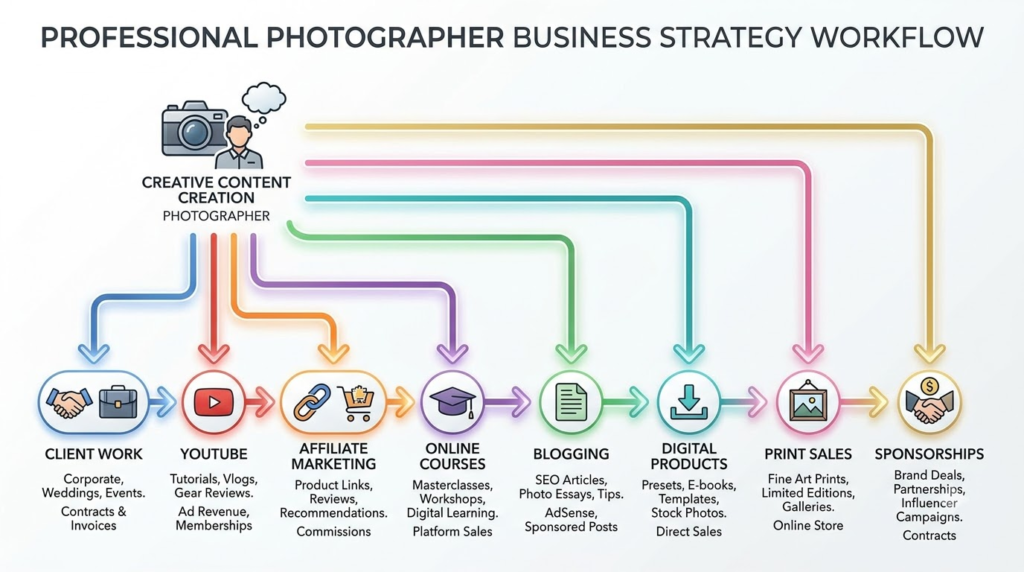
There is no universal best model. Choose the one that fits your current skills, local access and ability to reach buyers.
| Income model | Typical path to a first sale | Repeat potential | Main challenge |
|---|---|---|---|
| Local portraits and events | Direct outreach and referrals | Medium | Seasonality and lead generation |
| Business and commercial services | Targeted portfolio and outreach | High when clients need ongoing content | Longer sales cycle and higher expectations |
| Digital products and education | Audience, search traffic or partnerships | Potentially high | Discovery, trust and customer support |
| Blogging and creator media | Consistent publishing and audience growth | Potentially high | Slow start and platform dependency |
| Licensing and prints | Useful portfolio plus distribution | Variable | Finding buyers and maintaining volume |
For many beginners, a focused local service is the clearest test because it creates direct contact with a buyer. Digital products, licensing and media can be added later, after you understand what your audience actually needs.
A practical way to price for profit
Instead of copying another photographer’s price, build a minimum sustainable price from your own costs and workload.
For each offer, estimate:
- Pre-production time: planning, emails, contracts, shot lists and travel preparation.
- Production time: travel, setup, shooting and packing.
- Post-production time: backups, selection, editing, exports, delivery and revisions.
- Direct costs: transport, assistants, rentals, locations, printing, shipping and payment fees.
- Overhead allocation: software, website, insurance, storage, equipment replacement and marketing.
- Tax obligations: apply the rules relevant to your country and business structure.
- Desired return: the amount that makes the total commitment worthwhile.
Then compare your minimum sustainable price with what the target customer is willing to pay. If there is a large gap, change the offer, improve efficiency, serve a different customer or choose another niche. Do not hide the gap by ignoring your time.
How AI and smartphones change photography profitability
AI and smartphones increase pressure on generic, easily replaceable images. A client may not hire a photographer for a simple visual that can be produced adequately with existing assets or generated media.
However, many photography jobs depend on reality:
- A wedding or event must be captured as it happens.
- A property or product must represent the actual item.
- A portrait session requires direction and trust.
- A business may need consistent files, permissions and delivery standards.
- Documentary and editorial work depend on access and context.
Photographers can also use AI-assisted tools for appropriate administrative or production tasks, but generated content should not be presented as documentary evidence of something that did not occur. Client agreements should clarify what tools may be used and what level of authenticity is expected.
The practical response is not to compete with AI on volume. Build value around real access, judgment, service, consistency and accountability.
The minimum business system you need
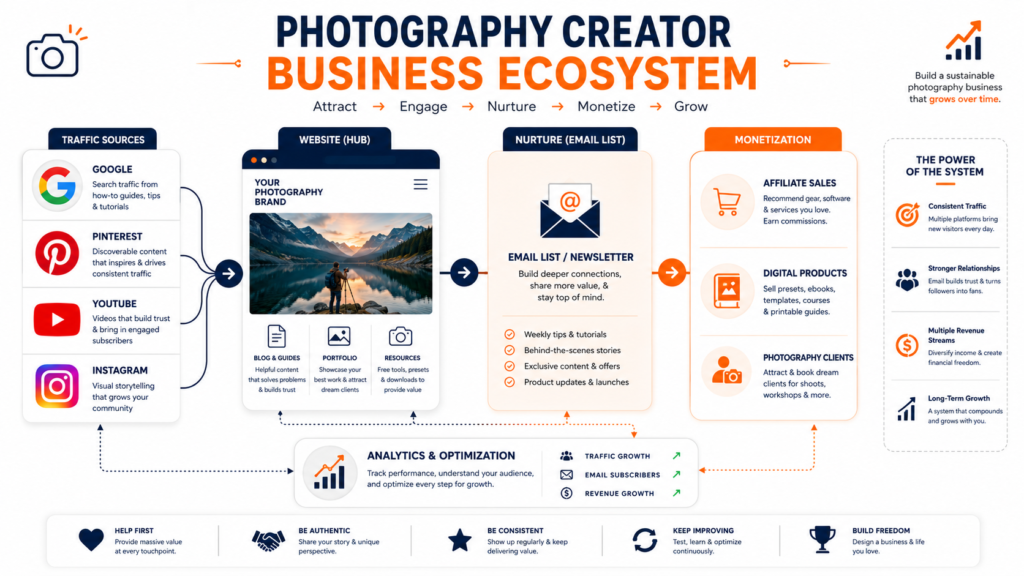
You do not need every platform or the newest camera to test a photography business. Start with a small system:
- A portfolio showing the exact work you want to sell
- One clearly described offer
- A simple inquiry or booking process
- Written terms covering payment, cancellation, delivery and usage
- A reliable capture, backup and delivery workflow
- A method for tracking leads, bookings, revenue and expenses
- One repeatable marketing channel
- A way to request reviews and referrals after successful work
Add tools only when they solve a real bottleneck.
Free 90-Day Photography Business Starter Plan
Do you want to test photography as a real business without wasting months guessing what to do next?
Enter your email below to unlock the complete 90-day action plan. It takes you from choosing one offer to contacting potential clients and measuring whether the idea can become sustainable.
Common mistakes that reduce photography profit
Confusing revenue with profit
A large invoice does not show what remains after travel, editing, fees, equipment and taxes.
Buying equipment before validating demand
New gear can improve a workflow, but it does not create a customer. Rent, borrow or work with your current equipment when it can safely meet the deliverable.
Offering too many unrelated services
A focused offer is easier to explain, market and improve than a portfolio with no clear customer.
Underestimating non-shooting time
Communication, planning, culling, editing, delivery and sales can take longer than the session itself.
Depending on one client or platform
A single customer, marketplace or social network can change quickly. Build direct relationships and keep an owned portfolio or email list.
Using vague agreements
Clarify payment, cancellation, rescheduling, deliverables, turnaround, revisions, archiving and usage rights before the shoot.
Making unsupported income promises
Another photographer’s revenue does not prove what a beginner will earn in a different market. Use your own costs and conversion data.
FAQs
Is photography still profitable in 2026?
Yes, it can be. The most viable businesses match a clear offer to a real customer need, price the complete workload and control costs. Profit is not guaranteed, and results vary by niche, location and sales ability.
Can beginners make money with photography?
Yes. A beginner can test a focused offer such as portraits, local business content or simple product photography, provided the work meets the promised standard. Start with one service, use clear expectations and improve from real customer feedback.
What is the most profitable photography niche?
There is no universal answer. A high-priced niche can also have high expenses, long sales cycles and complex production. The better question is which niche offers sufficient demand, manageable costs and repeatable delivery in your market.
How long does it take to become profitable?
There is no reliable universal timeline. A photographer with an existing network may find a client quickly, while a digital-product or content business may need a longer period to build traffic and trust. Track leading indicators such as inquiries and conversion—not only social followers.
Is stock photography passive income?
Licensing can generate repeated sales, but creating, uploading, keywording, releasing and maintaining a useful portfolio requires work. Treat it as a licensing business, not guaranteed passive income.
Is AI replacing photographers?
AI is changing demand for generic images and some production tasks. It does not remove the need to capture real people, products, properties and events, or to manage clients, permissions and reliable delivery.
Do I need an expensive camera to start?
You need equipment that can reliably produce the promised result, plus a safe backup plan when the job cannot be repeated. The correct kit depends on the service; price alone does not determine professional value.
Conclusion
So, is photography still profitable in 2026?
The answer is a clear yes, but the path to profitability looks different than it did a decade ago.
Photography is still profitable in 2026 for some photographers—but not because cameras automatically create income.
Profit comes from solving a valuable problem, reaching the right buyer, pricing the complete workload and delivering consistently. Client services can create a direct path to early revenue. Retainers can improve predictability. Digital products, licensing and content can add scale, but they usually require distribution, trust and ongoing maintenance.
Start with one audience and one offer. Track the real cost of every job. Improve the system before adding more services.
The photographers most likely to build sustainable businesses are not simply the people who create the most images. They are the people who understand what a customer values and can deliver it reliably.