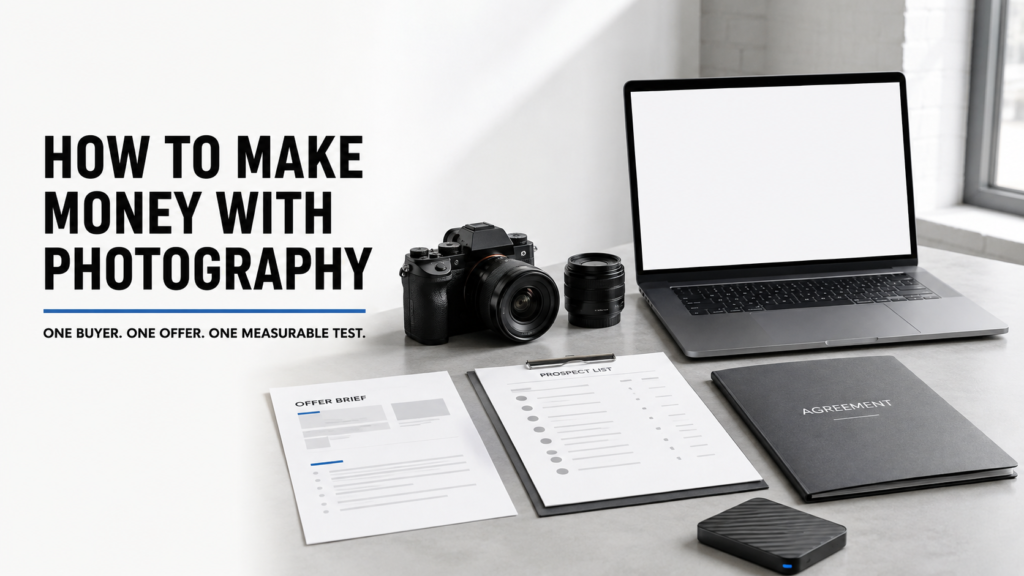
Learning how to make money with photography does not begin with buying more equipment or joining every available platform. It begins by identifying one reachable buyer, one useful problem and one result you can deliver responsibly.
Who can I reach, what useful result can I produce for them, and how will I test whether they will pay for it?
This guide turns that question into a practical seven-step system. You will choose one income route, define a controlled offer, create relevant proof, find qualified prospects, deliver the work professionally and review the evidence from your test.
If you are learning how to earn money as a photographer, start narrowly. Testing one clear offer for a specific buyer produces more useful information than launching several services, products or platforms at the same time.
This article does not promise a particular income or timeline. Your results will depend on your market, skills, access to customers, pricing, costs, available hours and local legal, tax and privacy requirements.
For global wage references and explanations of salary, revenue, profit and take-home pay, read How Much Do Photographers Really Earn in 2026?. If you are evaluating whether a photography business can remain sustainable after costs and working time, use Is Photography Still Profitable in 2026?.
The objective of this guide is different: build one focused offer that you can test, measure and improve using real evidence.
Table of Contents
How to Make Money With Photography: Choose a Testable Route
The most reliable way to learn how to make money with photography is to test one buyer, one offer and one measurable result.
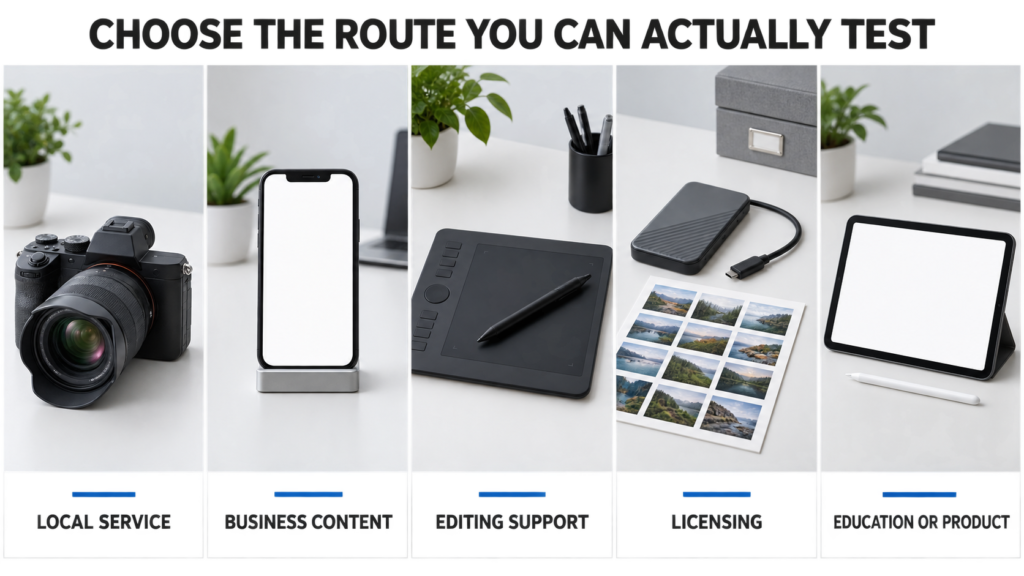
Photography can generate revenue through client services, repeat commercial work, licensing, products, education and content. A beginner does not need to launch all of them at once.
Choose the route that gives you the clearest access to a real buyer and the best chance to collect useful evidence.
| Your current advantage | First route to test | Evidence to collect |
|---|---|---|
| You can reach people or families locally | A focused portrait, event or community service | Enquiries, conversations, bookings, delivery time and referrals |
| You can reach businesses | Product, hospitality, property, headshot or recurring content service | Business problems, usage needs, repeat frequency and decision process |
| You have strong editing skills | Retouching or production support for photographers and organizations | Test-file quality, turnaround, revision load and repeat demand |
| You have an organized, useful image archive | Direct licensing or a carefully selected stock submission | Acceptance, buyer relevance, releases, downloads and net royalties |
| You repeatedly solve one learning problem | A narrow workshop, guide, template or review service | Questions, pre-orders, attendance, support demand and refunds |
| You already have relevant audience or search traffic | Content that supports services, products or disclosed affiliate offers | Qualified enquiries, attributed sales, email sign-ups and net revenue |
Do not choose a route only because someone online calls it passive or profitable. Choose it because you can identify the buyer, reach that buyer and deliver the result responsibly.
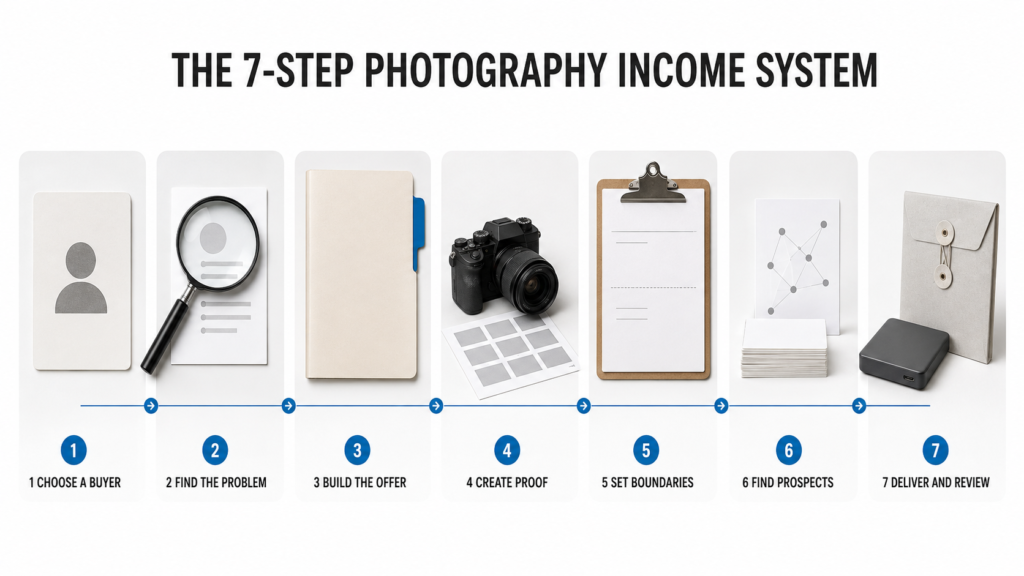
This system explains how to make money with photography without assuming that every method works in every market.
Step 1: Choose One Reachable Buyer
“Anyone who needs photos” is not a useful target.
A reachable buyer is a specific group you can research and contact. Examples include:
Independent restaurants in one city.
Property agents handling a particular area.
Local families seeking outdoor portraits.
Small online shops with inconsistent product images.
Event organizers serving one community.
Photographers who need a defined editing service.
Tourism businesses that license location-specific images.
Start with access, not fantasy. A small group you understand is more useful than a huge audience you cannot reach.
Buyer-definition template
Complete this sentence:
I help [specific buyer] obtain [specific result] by providing [defined photography service or asset] within [clear scope or delivery period].
Weak version:
I provide professional photography for everyone.
Stronger version:
I help independent restaurants in my city create a consistent set of menu and social photographs during one planned on-location session.
The stronger version is not guaranteed to sell. It is simply clear enough to test.
Step 2: Find a Problem Worth Solving
Do not begin by asking what you want to photograph. Begin by learning what the buyer needs to accomplish.
A business may need:
Accurate product images for a store.
A repeatable flow of campaign assets.
Staff headshots that match.
Faster property-listing delivery.
Images with clearly defined commercial usage.
A reliable archive and file-naming system.
An individual may need:
A documented life event.
A comfortable portrait experience.
Predictable delivery before a deadline.
Prints or an album, not only digital files.
Clear privacy expectations.
Five-question buyer interview
Ask a small number of real potential buyers:
What are you currently using photographs for?
What is difficult, slow or inconsistent in the current process?
What happens when the images are late, unsuitable or unavailable?
What would a useful result include?
How do you normally choose and approve a photographer?
Do not turn every conversation into a sales pitch. The goal is to hear the buyer’s language, constraints and decision process.
The U.S. Small Business Administration recommends market research and competitive analysis as part of planning a business. Readers outside the United States can apply the same research principle while checking their own local business rules and support services. SBA business-planning guidance
Step 3: Build a Minimum Sellable Photography Offer
A minimum sellable offer is the smallest professional package that produces a useful result without hiding important terms.
Define:
Buyer: Who the offer is for.
Result: What the work helps the buyer accomplish.
Deliverables: What files, products or services are included.
Production scope: Location, duration, preparation and people or products covered.
Delivery: Format, method and expected turnaround.
Revisions: What is included and what counts as additional work.
Usage: Personal use, commercial use, media, territory, duration and exclusivity where relevant.
Payment: Currency, deposit or milestone process, accepted method and due dates.
Cancellation: What happens when either party changes the plan.
Privacy and releases: How identifiable people, private locations and sensitive files are handled.
Do not advertise “unlimited photography” or “unlimited revisions” unless you can define and safely deliver that promise.
One-page offer template
Offer name:
Designed for:
Buyer result:
Included deliverables:
Not included:
Production process:
Delivery period:
Revision limit:
Usage rights:
Payment process:
Cancellation terms:
Next step:
Use a contract or written agreement suitable for your jurisdiction. Pixanded cannot determine the legal or tax requirements that apply in every country.
Step 4: Create Relevant Proof
A general gallery of attractive images is not always proof that you can solve a specific buyer problem.
Create three kinds of proof:
Result proof: Images that resemble the required outcome.
Process proof: A short explanation of planning, capture, editing, delivery and backup.
Reliability proof: Clear scope, response expectations, update dates and honest testimonials or references where available.
If you do not yet have client work, create a self-directed demonstration using your own products, an authorized location or consenting participants. Label it accurately. Do not present a practice project as paid client work.
For people or recognizable private property, check whether releases are required for the intended use. Adobe Stock, for example, requires model releases in defined situations and provides current contributor guidance. Adobe Stock model-release guidance
Proof-page structure
One sentence naming the buyer and result.
Six to twelve relevant images.
The constraints of the demonstration.
A short process explanation.
The deliverables and usage the offer includes.
One clear enquiry action.
Remove unrelated photographs. Relevance is more persuasive than volume.
Step 5: Set Boundaries Before Setting a Price
This article does not provide a universal price list. A responsible price depends on local currency, scope, costs, hours, usage and customer expectations.
Before quoting, estimate:
Planning and communication time.
Travel and setup.
Capture time.
Culling, editing and revisions.
Delivery and archiving.
Assistants, locations, props and production costs.
Payment and platform fees.
Equipment, software, insurance and other overhead.
The usage rights requested.
Applicable taxes and local obligations.
Use the Photography Earnings Worksheet to compare collected revenue, direct costs, overhead, hours and effective hourly return in your own currency.
State the scope and price together. A number without deliverables, rights and limits is not a complete quote.
Step 6: Build a Small Qualified Prospect List
Do not send the same message to hundreds of unrelated accounts.
Create a list of potential buyers who match the offer. Possible sources include:
Businesses you already know.
Local directories and professional associations.
Event, venue or community networks.
Referrals from complementary professionals.
Companies with a visible and relevant image problem.
Search results for a defined local or industry need.
Your existing clients, audience or professional contacts.
For eligible local businesses, an accurate Google Business Profile can help a business appear across Google services. Availability and verification requirements vary, so use Google’s current instructions. Google Business Profile guidance
Lead tracker
Track:
| Field | What to record |
|---|---|
| Prospect | Name, organization and relevant contact channel |
| Fit reason | The observed need connected to your offer |
| Contact date | When and how you contacted them |
| Response | No response, not now, interested, call, proposal or declined |
| Next action | Follow-up date or a clear closed status |
| Result | Booking, collected payment, reason lost or learning |
Respect local marketing, privacy and anti-spam rules. Use business contact channels appropriately and stop contacting people who opt out.
Step 7: Start a Useful Conversation
A strong first message is specific, short and based on the buyer’s situation.
Outreach template
Hello [name]. I noticed [specific, truthful observation]. I help [buyer type] create [relevant result] through [defined offer]. If this is a current priority, I can send a one-page outline showing the deliverables, process and usage options. If it is not relevant, no reply is needed.
Do not claim you reviewed a business when you did not. Do not invent urgency, customers, awards or results.
Referral request
I am testing a focused [offer] for [buyer type]. If someone in your network is actively dealing with [specific problem], would you be comfortable introducing us? I can send a short description you can review first.
Discovery-call questions
What will the images be used for?
Who needs to approve the work?
What must be included?
What must be avoided?
What is the required delivery date?
Which formats and usage rights are needed?
What has made previous attempts difficult?
What would make this project successful?
A good call can end with “not a fit.” Qualification protects both parties.
Deliver, Protect and Review the Work
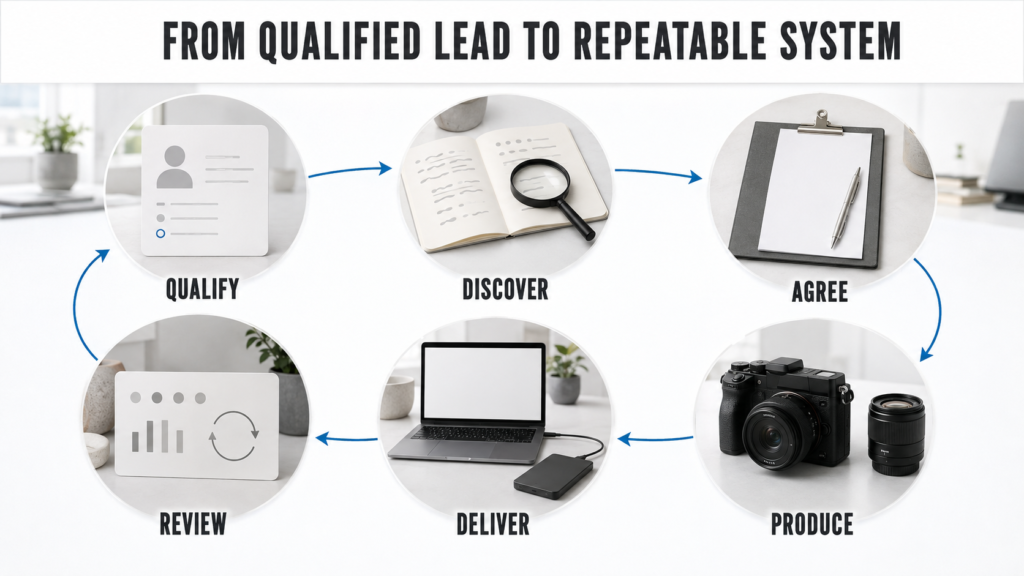
A booking is not the end of the system. Reliable delivery creates the evidence needed for repeat work and referrals.
Before production:
Confirm the written scope and usage.
Confirm payment milestones.
Create a shot or asset list.
Check location, access, timing and permissions.
Prepare equipment and backups.
Protect client contact and project data.
During delivery:
Use consistent file naming.
Check exports before sending.
Provide the agreed formats and instructions.
Keep client data only as long as necessary for the stated purpose.
Maintain a tested backup and recovery process.
CISA’s backup guidance recommends keeping important data in more than one place and testing recovery. Adapt the approach to your file volume, client confidentiality and local data rules. CISA data-backup guidance
After delivery:
Confirm receipt.
Record actual hours and costs.
Ask for specific, honest feedback.
Request permission before publishing client work.
Identify a genuine repeat need.
Record what should change in the next project.
If you use testimonials, affiliate links or paid recommendations, disclose material relationships clearly and follow the laws that apply to you and your audience. The FTC maintains current guidance for endorsements, influencers and reviews in the United States. FTC endorsement guidance
Pixanded Photography Offer Scorecard
The tools needed to make money with photography depend on the offer, but every workflow should support enquiries, payment, delivery and review.
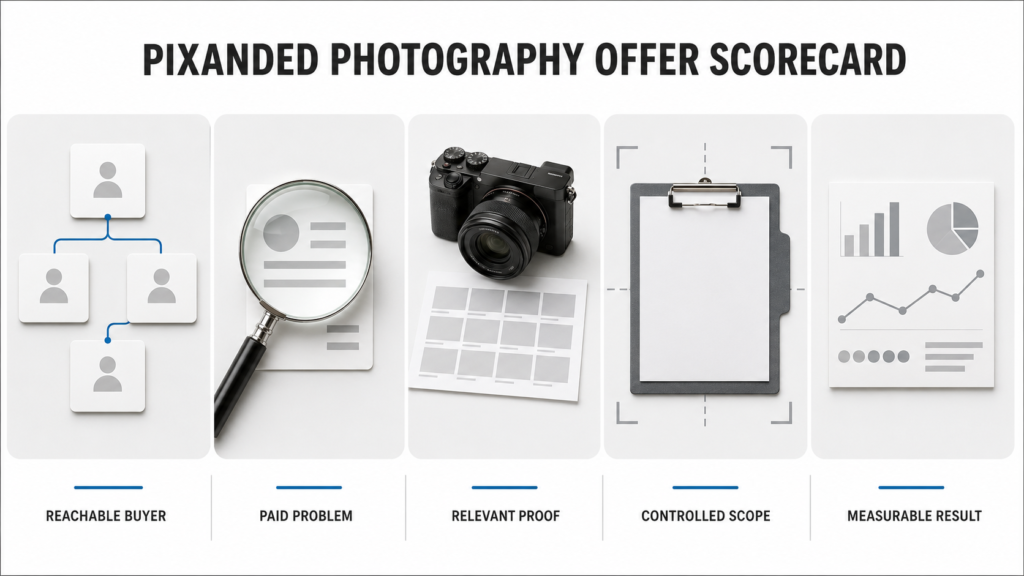
Before deciding how to make money with photography, evaluate the buyer, problem, proof, scope and measurable result.
Score each factor from 0 to 2.
| Factor | 0 | 1 | 2 |
|---|---|---|---|
| Reachable buyer | No defined buyer | Buyer defined but difficult to reach | Buyer defined with real contact routes |
| Paid problem | No clear need | Assumed need | Need confirmed through conversations or evidence |
| Relevant proof | No matching work | Partial or general proof | Specific result and process proof |
| Controlled scope | Open-ended promise | Some limits defined | Deliverables, revisions, usage and delivery defined |
| Measurable business result | Costs and hours unknown | Estimates incomplete | Costs, hours and collected revenue can be tracked |
Score interpretation:
- 8–10: The offer is clear enough for a controlled market test.
- 5–7: Improve the weakest factor before expanding outreach.
- 0–4: Choose a narrower buyer, problem or offer.
This scorecard is a planning tool. It does not predict sales or income.
How to Make Money With Photography: A 14-Day Offer Validation Sprint
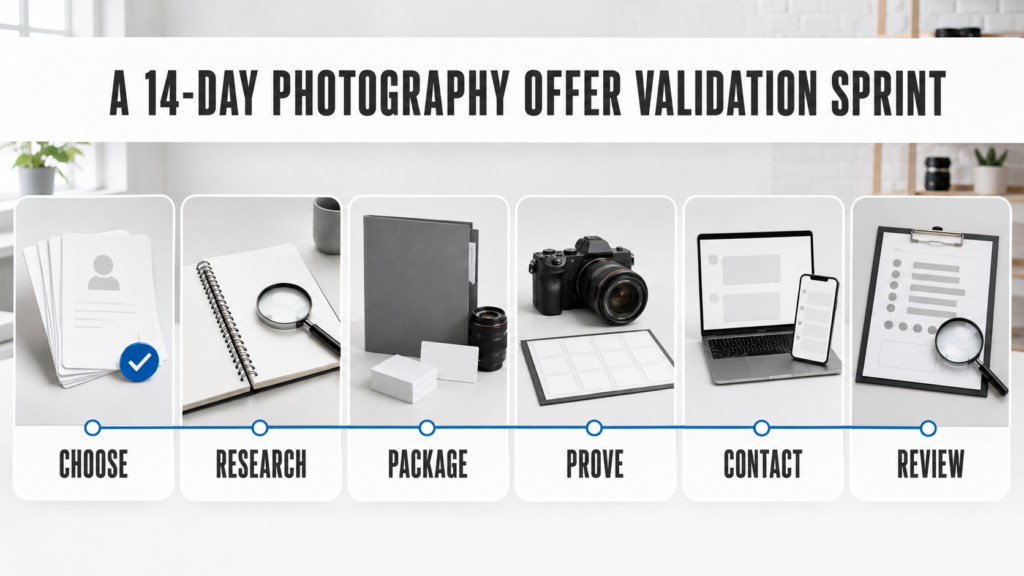
This sprint is designed to collect evidence, not guarantee a client.
Days 1–2: Choose
Select one reachable buyer group.
Choose one result you can deliver responsibly.
Write the buyer-definition sentence.
Days 3–4: Research
Review current alternatives in the buyer’s market.
Conduct or request several short buyer conversations.
Record needs, objections, required usage and approval process.
Days 5–7: Package
Complete the one-page offer template.
Define deliverables, exclusions, revisions and usage.
Estimate every production and delivery hour.
Prepare the written agreement and payment process.
Days 8–9: Prove
Select or create a relevant demonstration.
Build one focused proof page.
Check permissions, releases and captions.
Days 10–12: Contact
Build a small qualified prospect list.
Send personalized messages.
Track replies and objections without mass spam.
Days 13–14: Review
Count qualified conversations, calls, proposals and bookings.
Record repeated objections.
Compare the offer with the scorecard.
Decide whether to continue, narrow, change the proof or test another buyer.
A test with no booking can still provide useful evidence. It may show that the buyer is difficult to reach, the problem is weak, the proof is irrelevant, the scope is unclear or the market timing is wrong.
When to Add Another Income Stream
Add another route only when you can explain:
Where current enquiries come from.
Which offer converts and which does not.
The real delivery time and cost.
Whether customers repeat or refer.
Whether your files, knowledge or process can responsibly become a product or license.
For example:
Repeated business shoots may support a retainer.
Repeated client questions may support a narrow workshop.
A well-organized archive may support licensing.
A proven workflow may support a template.
A trusted audience may support disclosed affiliate content.
Do not turn every photograph into five products simply because repurposing is possible. The new use must have a real buyer and appropriate rights.
Common Mistakes When Trying to Earn From Photography
Starting with a platform instead of a buyer
A marketplace account is distribution, not demand. Define the buyer and use case first.
Using foreign prices as a personal forecast
Currencies, costs, rights, taxes and customer budgets differ. Build a local evidence base.
Publishing unrelated portfolio work
A buyer needs proof for their problem, not every image you have made.
Quoting before defining usage
Commercial use, duration, territory, media and exclusivity can change the value and risk of a project.
Pricing only the time spent shooting
Communication, planning, travel, editing, revisions, delivery, administration and backup also consume capacity.
Buying equipment before validating the bottleneck
Upgrade only when a measured requirement, reliability issue or delivery constraint justifies it.
Contacting too many people with the same message
Generic outreach produces little learning and can violate platform or local marketing rules.
Treating testimonials casually
Use genuine feedback, preserve its meaning and obtain permission before publishing identifying details.
Depending on one platform
Build direct records, a reliable website or portfolio and permission-based contact channels where appropriate.
FAQs
Can beginners really make money with photography?
Yes, a beginner can sell work that meets a real need, but skill level alone does not produce a sale. The buyer, proof, scope, reliability, price and access to the market all matter. Do not promise results you cannot deliver.
What is the fastest way to make money with photography?
There is no guaranteed fastest route. A focused service can produce direct market feedback when you already have access to suitable buyers. Licensing, products and content may take longer to validate because they depend on distribution, search or an audience.
How do I get my first photography client?
Choose a specific reachable buyer, learn what result they need, create relevant proof, define a controlled offer and contact qualified prospects with personalized messages. Track objections and improve the weakest part of the system.
Do I need an expensive camera?
No universal camera requirement exists. Use equipment that can reliably produce the promised result. Rent, borrow or upgrade only when a defined technical or reliability need justifies it.
Can I make money with smartphone photography?
A smartphone may be sufficient for some social, product, property or content assignments, but not every job. Confirm resolution, color, lighting, lens, file-format, backup and delivery requirements before accepting the work.
Is stock photography a good beginner route?
It can be a useful test for photographers with relevant, properly released images and a disciplined metadata workflow. It is not automatic passive income. Platform acceptance, royalties and buyer demand vary. Adobe currently publishes its contributor royalty structure and submission requirements; verify the current rules before uploading. Adobe Stock royalty guidance
How long does it take to earn money from photography?
There is no responsible universal timeline. Access to buyers, proof, local demand, sales activity, availability and delivery quality all change the result. Use the 14-day sprint to collect evidence, not to promise a payment date.
Do I need to register a business?
Requirements differ by country, region, activity and income level. Check the appropriate local tax authority, licensing office and qualified adviser before accepting work or selling internationally.
Final Takeaway
Learning how to make money with photography requires controlled testing—not income promises or unrealistic shortcuts.
To make money with photography, start with one reachable buyer and one useful result.
Research the problem. Define the offer. Create relevant proof. State the scope, usage and payment process. Contact qualified prospects. Deliver reliably. Measure the result.
Do not judge progress only by followers, likes or invoices sent. Track qualified conversations, proposals, collected revenue, costs, hours, repeat work and referrals.
When the first system is understood, you can improve it or add a carefully chosen income stream. Until then, clarity is more valuable than complexity.