You can start freelance videography with no clients by creating an honest sample of the work you want to sell, defining a manageable service and approaching businesses that have a relevant use for it. You do not need to invent commissions or wait until you own a full production kit.
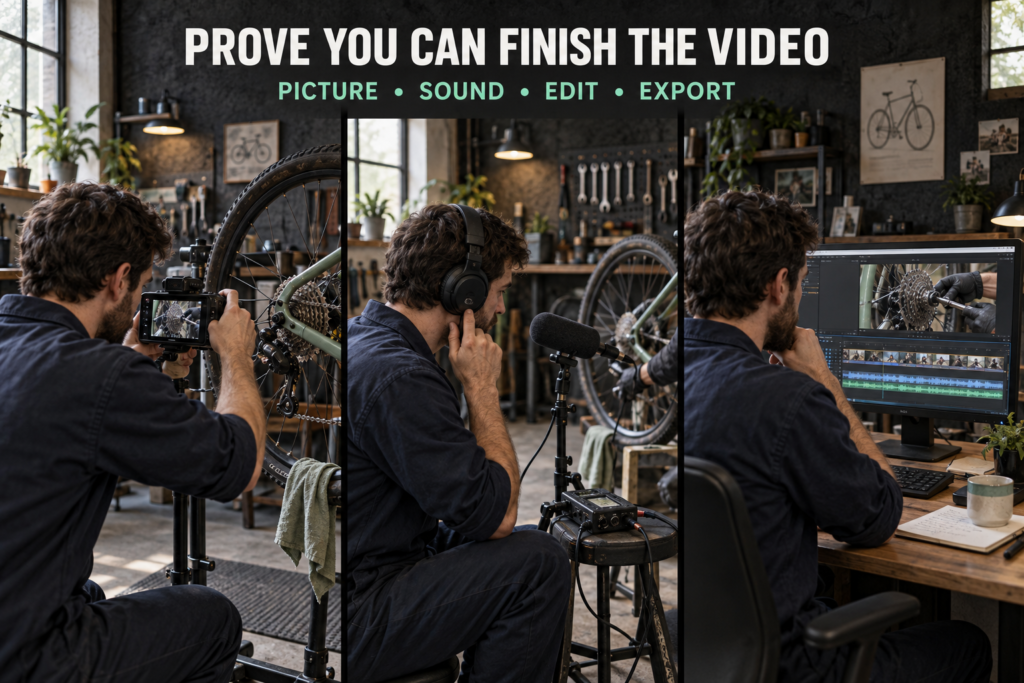
The difficult part is proving that you can handle a complete assignment: understand the brief, capture usable picture and sound, edit a clear story, manage feedback and deliver the agreed files. A visually impressive montage alone does not demonstrate all of those skills.
This guide follows a practical first-project workflow. Its sample business, offer and schedule are hypothetical teaching examples, not a report of client results or a promise of paid work.
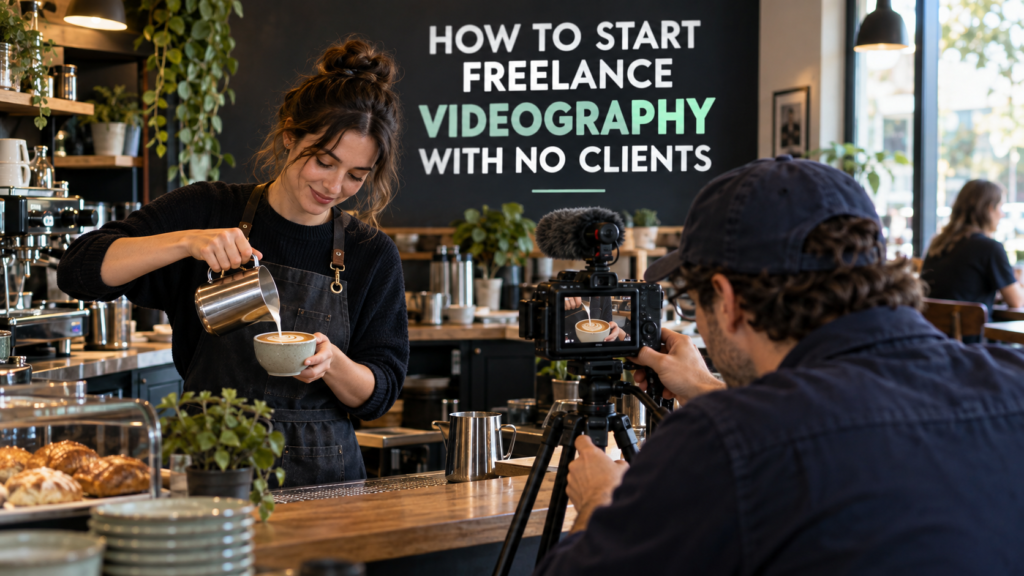
1. Choose one buyer and one video use case
Start with a sentence that identifies who you help and what you deliver: “I create short process videos for independent businesses that want to explain a service.”
Make it narrower for your first test. A bicycle repair shop explaining a routine service is easier to plan around than an offer to make any video for any business. You can identify the subject, the action to film, the person who approves the work and where the finished video will appear.
Possible starting points include an owner introduction, a product demonstration or a short explanation of a service. Choose something you can rehearse and reshoot. A once-only event, complex live production or assignment involving multiple locations may leave little room to recover from a beginner’s mistake.
Before committing, answer three questions:
- Can I access an appropriate subject and location with permission?
- Can I produce the required footage and sound with equipment I can reliably use?
- Can I show how the finished video serves a specific viewer?
Define success initially as a useful, correctly delivered video. A promise of sales, bookings or viral reach adds an outcome you do not control.
2. Check your ability to finish the job
Test the whole workflow with the equipment you already have access to. A phone or camera is useful only if you can obtain consistent results under the conditions of the assignment.
Record a short practice sequence: an establishing view, a medium view of an action and a detail. Check focus, exposure, distracting background elements and whether the shots can cut together. If the project includes speech, record it in the actual type of environment you expect to use, then listen with headphones.
Export the edit and watch the exported file on a phone and computer. Look for missing media, unreadable text, awkward cuts and sound that becomes difficult to understand on small speakers.
Use this readiness checklist:
- Picture remains usable through the planned action.
- Speech is understandable and free of avoidable clipping or distracting noise.
- You can assemble a beginning, middle and ending.
- You can correct captions and export a file that plays properly.
- You can copy, organize and recover your recorded media.
If a test fails, simplify the assignment or practise the missing skill before offering it. Borrowing or renting an item can solve a defined limitation, but unfamiliar equipment creates another task to learn. For support equipment, Pixanded’s guide to tripods for photography and video explains considerations relevant to still shots and camera movement.
3. Create an honestly labeled sample project
A self-initiated project can demonstrate your skills without pretending that somebody hired you. Ask an appropriate business owner or participant whether they would like to take part in a clearly scoped portfolio exercise.
Explain the filming, intended publication and any proposed use of their premises, identity or products before recording. Agree separately whether they may use the finished video and whether you may publish it in your portfolio. Confirm any locally applicable consent, release or location requirements; one person’s permission should not be assumed to cover everyone or everything in a scene.
Label the published work accurately:
“Self-initiated portfolio project, produced with the participant’s permission. My role: planning, filming, sound recording and editing. No paid commission or measured commercial results are claimed.”
If the participant received the film for free, say so when the context could otherwise imply a paid commission. Use the actual arrangement, not a more impressive description.
A complete hypothetical sample brief
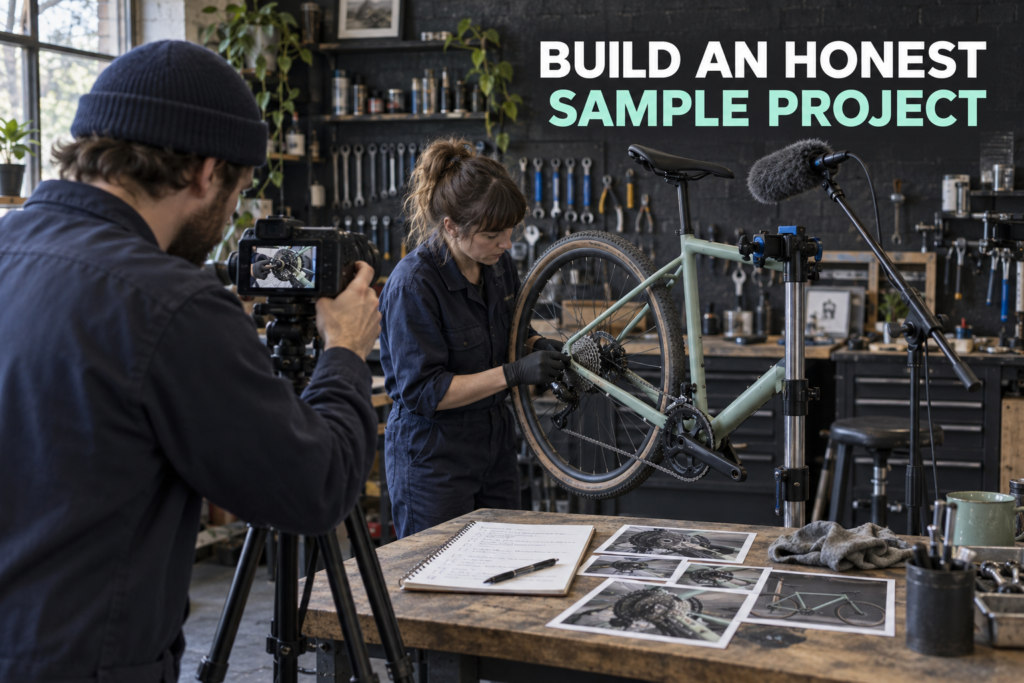
Imagine an independent bicycle repair shop agrees to a portfolio exercise during a quiet period.
| Brief field | Hypothetical agreement |
|---|---|
| Audience | Local bicycle owners unfamiliar with the shop’s routine service |
| Purpose | Explain what happens during a service and invite viewers to contact the shop |
| Core message | The mechanic checks the bicycle, explains the work and hands it back ready for the agreed use |
| Deliverable | One 30–45-second vertical video with checked captions |
| Filming | One shop, one participating adult mechanic, up to two hours |
| Content | Arrival, inspection, selected work details, final check and owner-approved contact instruction |
| Audio | Short recorded explanation and controlled workshop sound; music only if appropriate rights are confirmed |
| Approval | The owner checks factual statements and submits one consolidated feedback list |
| Publication | Portfolio publication and any business use agreed in writing before release |
Prepare a short shot list from the brief. For example: workshop exterior, mechanic receiving the bicycle, inspection, close-up of an adjustment, final check and handover. Film real work accurately; ask the mechanic to verify the sequence rather than staging unsafe or misleading repair instructions.
Keep unrelated customers out of the planned filming area. Do not invent a testimonial or attach a sales claim to the finished sample.
4. Present evidence that explains your contribution
Build a small portfolio page around the completed sample. A single relevant, finished project can support a targeted conversation better than a collection whose purpose is unclear.
Include the video, the brief, your role, the constraints and the deliverables. Explain one production decision: perhaps you used a quiet interview corner because machinery interfered with speech, or chose close-ups to make a small process visible.
Distinguish your own camera work and editing from any collaborator’s work or licensed stock material. If you use supplied footage, do not imply that you filmed it. Do not use stock footage as evidence of on-location shooting ability.
Give a visitor a simple next step: describe their business, intended video use and approximate deadline. Test the portfolio link on a phone and without signing into your own account.
5. Define a first offer with boundaries
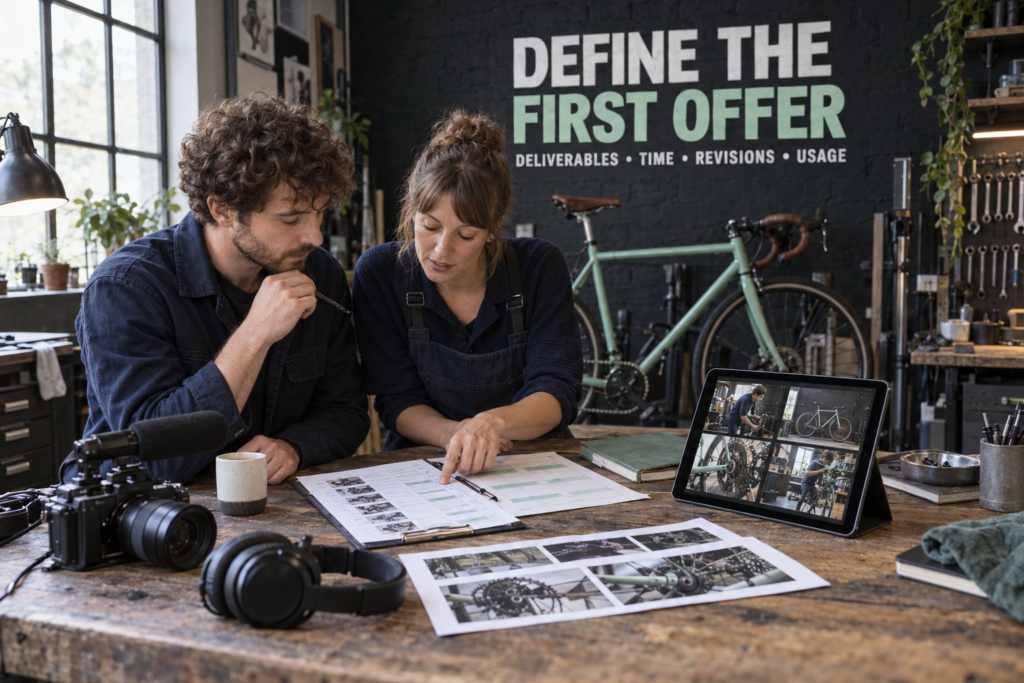
Translate the sample into an offer you can repeat. The first offer should explain what a buyer receives, what they must provide and what would change the quote.
For the hypothetical workshop project, a paid pilot could include:
- One preparation call and an agreed shot list.
- Up to two hours filming at one location with one adult spokesperson.
- One 30–45-second vertical edit, with a captioned version and a clean version of the same edit.
- Basic sound cleanup and color correction.
- One consolidated revision round within the approved brief.
- First review delivery within five business days after filming, assuming required client materials arrive on time.
- Final delivery within two business days after consolidated feedback, subject to the agreed scope.
A clean version is the same edit without burned-in captions; it is not a second concept. Define the actual exported dimensions and intended publishing channels in the agreement. For example, 1080 × 1920 can be the agreed vertical delivery size, rather than a claim about every platform’s requirements.
List exclusions: extra locations, reshoots caused by a changed brief, additional speakers, translation, animation, raw footage, project files, posting, advertising management and additional edits unless quoted.
Define the intended usage as well. In this example, the proposed scope is the business’s own website and organic social accounts for 12 months, with worldwide online visibility and non-exclusive use. Paid advertising and third-party use require a scope review. Those are illustrative negotiating terms, not a standard licence.
6. Find prospects with a specific reason to talk
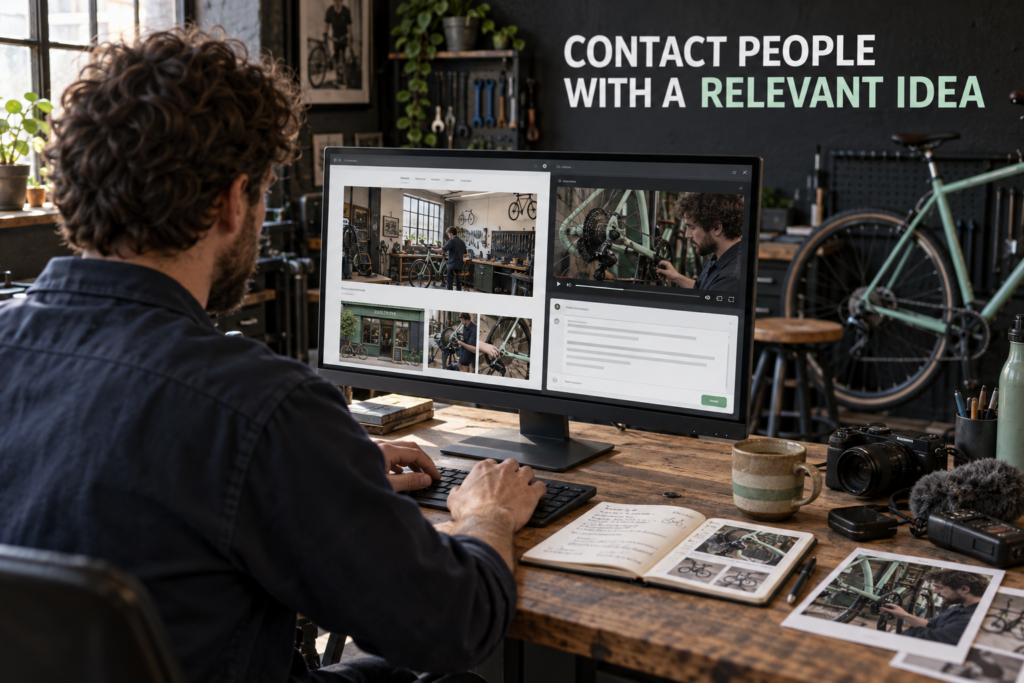
Research businesses that match the work you can demonstrate. Look for an actual service, product or customer question that the video could help explain. Check that the business is active and that you are approaching an appropriate contact.
Keep a simple record of the business, relevant observation, proposed idea, contact route, message date and response. Do not assume a business needs video just because it has not posted recently.
Start with a manageable test group—for example, ten carefully researched prospects. This is a workload choice, not a success-rate forecast. Personalize the idea and follow the rules applicable to the contact channel and jurisdiction. Respect requests not to be contacted.
A first outreach example
Adapt the following only after confirming the observation is true:
“Hello, I noticed your website explains the steps in your bicycle service. I create short videos showing how independent businesses work, and a brief inspection-to-handover video could help customers understand that process. Here is a self-initiated sample showing my filming and editing. Would a short conversation about a single-location paid pilot be useful? I can send a defined scope before you decide.”
Insert your genuine sample link. Avoid invented mutual contacts, claims that you have already helped similar clients or promises to increase sales.
One respectful follow-up
After an appropriate interval, if the channel and local rules allow:
“Hello, I’m following up on the short service-video idea I sent. If it is relevant, I can outline the filming time, deliverables and price. If it is not a priority, no problem—I’ll leave it there.”
A week can be a reasonable planning interval, but it is not a universal rule. Stop after a decline or an opt-out. Silence does not authorize repeated messages.
7. Turn interest into a written project brief
Use the discovery conversation to clarify the assignment before discussing creative extras.
Ask who the video is for, what the viewer should understand or do, where it will appear and whether it will be used in paid advertising. Confirm the date, location, available participants, budget range, decision-maker and feedback process.
Discuss practical constraints: noisy machinery, limited access, confidential information, customers in the background and the owner’s availability. Ask who supplies approved names, contact details, logos and any factual claims.
Send a written brief covering the message, shot list, deliverables, schedule, rights, client responsibilities and exclusions. Obtain agreement before filming. If the client asks for another concept or format later, estimate the effect on time and cost before accepting it.
8. Quote all the work and agree payment terms
Estimate planning, travel, setup, filming, media handling, editing, caption checks, feedback, exporting and administration. Add job-specific expenses and an allocation for business overhead. Define your labor allowance and intended margin, then review any separate licensing or additional deliverables.
For the underlying cost-floor and margin method, use Pixanded’s guide to pricing photography services. Apply the method to your actual video workflow; photography examples are not video market rates.
For a hypothetical scheduling estimate, allow 1.5 hours for planning, 1 hour for travel, 2 hours on site including setup, 0.5 hour for ingest and backup, 3.5 hours for editing and captions, and 1.5 hours for feedback, exporting and administration. That is 10 business hours, not a two-hour job. Adjust each assumption after a practice run and allow for uncertainty.
Agree the payment schedule, when work begins, cancellation or postponement arrangements, acceptance process, file delivery and any rights that depend on payment. Check the local treatment of deposits, invoices and tax rather than copying another country’s terms.
If the client’s budget is too low, reduce scope transparently. Removing a second edit or simplifying filming is clearer than keeping every promise and hoping the extra time disappears.
9. Prepare the shoot and protect the footage
Before filming:
- Confirm the brief, access time, participants, permissions and approval contact.
- Check batteries, recording media, camera settings and microphone operation.
- Rehearse the essential sequence and identify a quieter recording position.
- Confirm the client’s supplied facts and intended call to action.
- Leave time to check recorded picture and sound before leaving.
Record the essential story first, then optional details. Review key takes while the subject and location remain available.
After filming, make verified copies on separate storage devices before reusing recording media. Open representative files and confirm that copies are complete. Keep project files organized and maintain another protected copy appropriate to the assignment. Agree retention and deletion dates with the client rather than promising indefinite storage.
10. Edit to the brief and check music rights
Assemble a clear sequence, make speech understandable, check names and captions, and remove shots that do not help the agreed message. Ask the client to confirm factual statements before approval.
Choose music only after confirming it can be used in the intended client project, publishing channels and advertising context. Keep evidence of the licence, any attribution requirement and the project it covers. A label such as “royalty-free” does not by itself describe every permitted use.
For U.S. context, the Copyright Office explains that a musical composition and its sound recording are separate works that can be owned and licensed separately. Do not assume permission for one automatically covers the other. U.S. Copyright Office: musical works and sound recordings
YouTube’s Audio Library guidance distinguishes tracks requiring attribution and notes limits to the guidance it can provide for off-platform use. Check the actual track terms before using music in a client’s website, social campaign or advertisement. YouTube Audio Library guidance
If suitable rights are unclear, use appropriately recorded speech and ambient sound without a music track. Watch for music accidentally captured from a shop radio as well.
11. Deliver files the client can actually use
Send a review copy with clear instructions: one decision-maker should collect feedback into one list, preferably with timestamps. Separate corrections to your work from a new request that changes the approved brief.
Before client work final delivery:
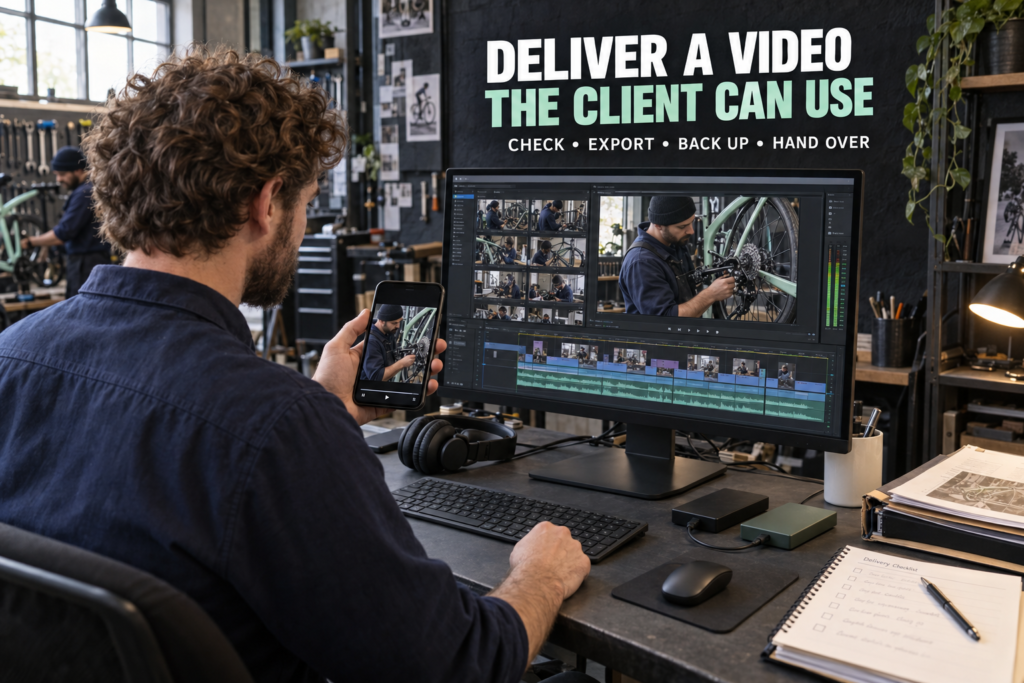
- Watch every exported file from beginning to end.
- Check the agreed duration, orientation, dimensions and file type.
- Listen on headphones and a phone speaker.
- Check captions, spelling, names and contact information.
- Confirm that temporary placeholders and unintended watermarks are absent.
- Check supplied assets, publication permissions and music documentation.
- Test the delivery link from outside your own signed-in account.
- Label final files clearly and explain which version to use.
Include the agreed usage summary, any required credits, delivery-link expiry and retention date. State whether raw footage or editable project files are included. Ask the client to confirm receipt and that the files open.
12. Run a 30-day practice and outreach test
Use a month as an organizational window, not a deadline for winning a client.
| Period | Actions | Review evidence |
|---|---|---|
| Week 1 | Choose a buyer and use case; run picture, sound and export tests; arrange a permitted sample | A feasible brief and a list of skills still needing practice |
| Week 2 | Film, edit and publish the labeled sample; document time and your contribution | A working portfolio link and an actual workload record |
| Week 3 | Define the paid pilot; research ten suitable prospects; send appropriate personalized messages | Recorded reasons for fit, messages and responses |
| Week 4 | Hold discovery conversations if invited; follow up appropriately; review objections and delivery readiness | A decision about what to change in the offer, proof or targeting |
If there are no replies, first check whether messages reached suitable contacts and whether the idea was relevant. If people reply but do not request a quote, examine the clarity of the offer and the sample. If they decline the quote, ask about scope and fit when appropriate; do not assume price is the only issue.
If you complete a paid pilot, compare estimated and actual hours, revisions and expenses. Ask permission before using client work or feedback publicly. Report commercial results only when you have reliable evidence and permission to share them.
The next useful step may be a stronger sample, a narrower offer or more practice. Buying more equipment is justified when it solves a demonstrated production limitation.
Can I start freelance videography without paid experience?
Yes. You can create self-initiated work with appropriate permissions and label it honestly. Use it to demonstrate the specific tasks you can perform; it does not establish a history of paid client delivery.
Should I make the first video for free?
A voluntary portfolio collaboration can be useful if both sides understand the scope and usage. It is not required. A defined paid pilot is another option once you can reliably deliver. Avoid unlimited free work based on an assumed future booking.
Do I need an expensive camera?
Your equipment must meet the agreed assignment. Test image quality, sound, recording reliability and export quality before accepting the work. Upgrade only when your existing setup cannot handle a demonstrated requirement.
How long does it take to find a first client?
There is no dependable universal timeline. Your skills, evidence, offer, contacts, location and buyer demand all matter. Track actions and responses rather than treating a fixed number of days as a booking promise.
What if a client asks for changes beyond the agreement?
Explain which request changes the approved scope, estimate the additional work and obtain agreement on the revised price and schedule before proceeding.
Can I put every client work video in my portfolio?
Do not assume so. Agree portfolio publication separately and check participant permissions, confidentiality and any restrictions on supplied or licensed assets before sharing.
This guide provides general educational information. The example project and schedules are hypothetical; they do not guarantee clients or income. Business, tax, consent and licensing requirements depend on the location and assignment.