
A client asks, “Can you create some photos and a short video for us?” That is an enquiry, not yet a defined assignment.
Before you quote, turn the request into a photography or video brief that explains the purpose, deliverables, working conditions and approval process. You can then estimate the work with fewer unanswered questions.
This guide includes an original question list, a hypothetical café example and a reusable brief structure. It focuses on defining an assignment after an enquiry arrives. For finding prospects, see How to Start Freelance Videography With No Clients.
Table of Contents
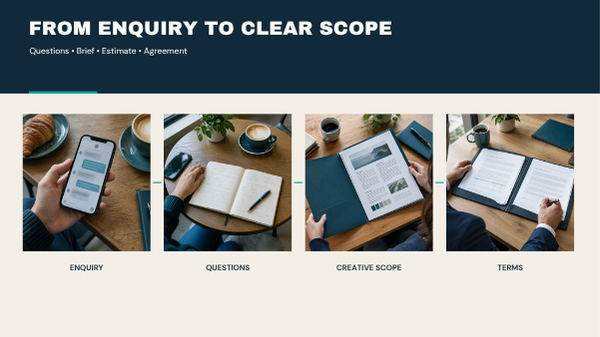
1. Keep the photography or video brief, estimate and agreement distinct
A brief describes the intended work. An estimate sets out the proposed price and assumptions. An agreement addresses the terms governing the assignment. They can refer to one another, but a brief alone should not be treated as a complete contract.
| Document | Main purpose | What to establish |
|---|---|---|
| Creative brief | Describe the assignment | Goal, audience, scope and deliverables |
| Estimate or quote | Explain the proposed charge | Included work, assumptions, expenses and additions |
| Agreement | Record the applicable terms | Payment, permissions, rights, responsibilities and other terms appropriate to the job |
Adobe’s creative-brief guide describes a brief as a framework for goals and scope. The practical template below adapts that general idea to a small photography or video assignment.
Use locally appropriate professional advice for the agreement. This article’s questions and sample brief are planning tools.
2. Ask what the content should help someone do
Start with the purpose. “We need content for social media” does not explain the intended audience or message.
Ask:
- Who should see the work?
- What should they understand, notice or do afterwards?
- What is the main message?
- Where will the finished work appear?
- What has worked or disappointed the client before?
- Is there a particular launch or deadline?
For a café, the goal might be to show the seating, drinks and atmosphere to nearby people considering a visit. That is more useful than a promise to “make the business go viral.”
Keep desired outcomes separate from guarantees. You can define the content you will produce; you cannot promise a particular level of sales or reach from a small creative assignment.
3. Turn “some content” into deliverables
Ask for a count, format and intended use. Then describe exactly what you plan to hand over.
For photographs, establish the number of edited images, orientations, delivery format and required subjects. Clarify whether advanced retouching is part of the work.
For video, establish the number of finished videos, approximate duration, aspect ratio, whether speech is required and any expected captions or text.
Avoid assuming that a vertical edit also includes a separate horizontal version, or that “all photos” includes every captured frame and working file.
| Vague request | A clearer question |
|---|---|
| A short video | How many finished edits, about how long, and in which aspect ratio? |
| Photos of the business | Which people, spaces and products must appear, and how many edited images? |
| Make it professional | Which reference qualities matter: lighting, pace, framing, tone or finish? |
| We need all the files | Do you mean final approved exports, selected source footage or project files? |
| Use it everywhere | Which channels, advertising uses, territories and duration should the estimate cover? |
Record exclusions alongside inclusions so the client can see what would require a new discussion.
4. Confirm the location and access conditions
A deliverables list is incomplete without the conditions needed to create it.
Ask whether the location is available, who can approve access and whether normal business activity can continue during production. Identify the people who need to be present and what must be prepared before arrival.
For food, products or interiors, ask who will prepare the scene. For an interview, ask who will speak, where it can be recorded and whether you can reduce disruptive noise.
A two-hour visit does not mean two uninterrupted hours of recording. Setup, movement between shots and interruptions consume time.
Before quoting, identify assumptions that affect the work:
- One agreed location or several?
- One production visit or multiple sessions?
- Available adults prepared to appear on camera?
- Quiet interview time or normal service noise?
- Products ready or preparation required on arrival?
- Access to power and a practical staging area?
- Permission to feature the people, location and supplied materials?
Do not leave those matters to be discovered after the price has been accepted.
5. Define use before choosing the fee
Ask how the client plans to use the work. Distinguish their own website and organic social posts from paid advertising, packaging, third-party distribution and other uses.
Record the intended media, duration, territory and whether exclusivity is requested. Ask separately whether you may use selected finished work in your own portfolio.
ASMP’s licensing example illustrates how a photography estimate can describe production and licensing separately. Its historical job details are not current pricing benchmarks or terms to copy.
This conversation helps you prepare the estimate and agreement. It does not replace checking the applicable permissions and rights for the actual project.
For cost calculations, use the method in How to Price Photography Services for Beginners.
6. Establish one approval route
Ask who can approve the brief, who will provide feedback and who gives final approval.
For a small assignment, a named client contact and a consolidated feedback list can keep instructions manageable. If several people need input, ask the contact to gather it before sending a revision request.
Define what a revision round means. For example, one round might mean one collected set of changes to the supplied first edit within the agreed scope. A new shoot, a different concept or extra deliverables would be discussed separately.
Also distinguish correction of a delivery error from a newly requested addition. Writing down an approval process is not a reason to ignore a file that fails the agreed specification.
7. Work through a hypothetical café enquiry
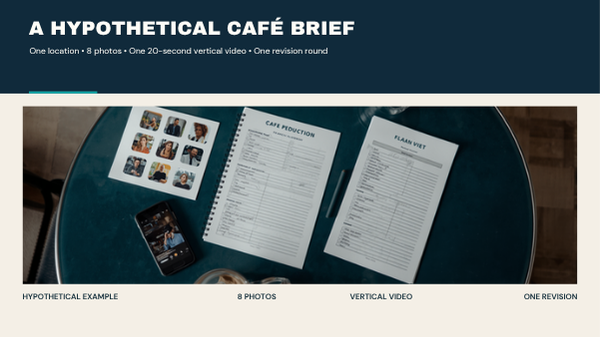
This is a hypothetical planning example. It is not a completed Pixanded commission, a standard package or a price recommendation.
The enquiry says: “We need a few photos and a short reel for our café.”
After questions, the proposed brief becomes:
| Brief field | Hypothetical agreed description |
|---|---|
| Purpose | Show the café’s seating, drinks and welcoming atmosphere to potential local visitors |
| Audience | People considering a nearby café visit |
| Location and production window | One café; one planned two-hour visit, including setup and filming |
| People | Two consenting adult staff members prepared to appear; incidental customers excluded from planned shots |
| Photographs | 8 selected and edited JPEG images; agreed mix of portrait and landscape orientations |
| Video | One 20-second vertical 9:16 edit; no spoken interview |
| Coverage | Exterior, interior, drink preparation, finished drinks and a staff interaction |
| Client preparation | Clean selected areas, prepare drinks and provide approved logo/text assets before the visit |
| Audio and text | Licensed music appropriate to the agreed use if included in the estimate; supplied factual text approved by the client |
| Delivery | First version within five business days after the shoot and receipt of required assets |
| Feedback | One consolidated revision round within the agreed concept |
| Intended use | Client’s own website and organic social channels for 12 months; wider use discussed separately |
| Exclusions | Paid advertising rights, additional versions, raw footage, project files and reshoots |
| Approval | One named client contact approves scope and consolidates feedback |
These details describe a possible project. Feasibility and price still depend on the actual location, preparation, production method and rights arrangements.
If the client also needs an owner interview, add the audio setup, interview time and editing to the proposed scope. Do not quietly absorb a different assignment into the same description.
8. Send a concise scope confirmation
Use this original message structure after the discussion:
“Thanks for explaining the project. My understanding is that the content should help \[audience\] understand \[message\] for use on \[channels\]. I propose \[deliverables\] from \[production plan\], with \[delivery timing\] and \[feedback process\]. The estimate will cover \[defined use\] and the assumptions listed in the attached brief. Please confirm those points, or tell me what needs to change, before I prepare the final quote.”
Keep the message factual. Do not claim approval until the client has actually responded through the agreed route.
Version the brief with a date or simple version number. When something changes, update the relevant section so both parties can identify the current scope.
9. Handle additions before doing the work
Suppose the café asks for a second location, a horizontal edit and paid advertising use after receiving the estimate.
Use a simple change process:
- Describe the requested addition.
- Check production time, editing, expenses and rights.
- Explain which deliverables or dates would change.
- Issue a revised estimate or written change proposal where needed.
- Obtain the agreed confirmation before starting the additional work.
A request that looks small in a message can affect several stages. An extra version may require a different crop, new graphics, more editing or a different usage arrangement.

10. Reuse this brief structure
For your next enquiry, create a document with these fields:
| Section | Fill in |
|---|---|
| Goal and audience | Purpose, intended viewer and main message |
| Deliverables | Counts, formats, lengths, orientations and finish |
| Production plan | Location, visit count, people, preparation and schedule |
| Client inputs | Assets, factual claims, products and approval deadlines |
| Use and permissions | Intended channels, duration, territory, exclusivity and relevant permissions |
| Delivery and feedback | First-version date, feedback route and revision scope |
| Assumptions and exclusions | Conditions supporting the estimate and work not included |
| Approval and version | Current version and the person responsible for confirmation |
Use the brief to check that the estimate reflects the actual work. Revisit it before the shoot, before editing and before final delivery.
Frequently asked questions
Should I quote before asking questions?
You can explain how your pricing works, but a firm project quote needs enough detail to understand the work and assumptions.
Is a creative brief a contract?
A brief records the creative scope. Use an appropriate agreement for the terms of the actual assignment.
What if the client does not know what they want?
Ask about the audience, message and intended channels. Offer a specific proposed scope they can assess rather than an unlimited promise.
Should raw files be included?
Discuss them explicitly. Final exports, source footage and project files are different deliverables with different practical implications.
How do I stop revisions becoming unlimited?
Define the feedback route and included revision scope in advance, then discuss additions before doing them.
The useful result is a shared description of the assignment: what you will make, what the client must provide, how it will be used and how it will be approved. Once that is clear, the estimate can describe a real project rather than a guess.