A photograph can sometimes be licensed more than once. A preset can be delivered to many customers. A useful tutorial can keep attracting readers after publication. Those are real examples of passive income for photographers, but none of them is automatic, guaranteed or maintenance-free.
The more accurate term is scalable photography income: revenue connected to an asset that can be sold, licensed or accessed repeatedly without recreating the entire deliverable for every buyer.
That distinction matters. A stock library needs research, releases, metadata and new uploads. A digital product needs testing, support, updates and refund handling. A print collection needs quality control and reliable fulfillment. An educational resource needs accurate content, distribution and maintenance.
This guide shows you how to make passive income as a photographer and how to choose one repeatable photography asset, check whether you control the rights, estimate its economics in your own currency, run a small demand test and decide whether to improve, scale or stop. It does not predict what you will earn.
Table of Contents
What “passive income” means in a photography business
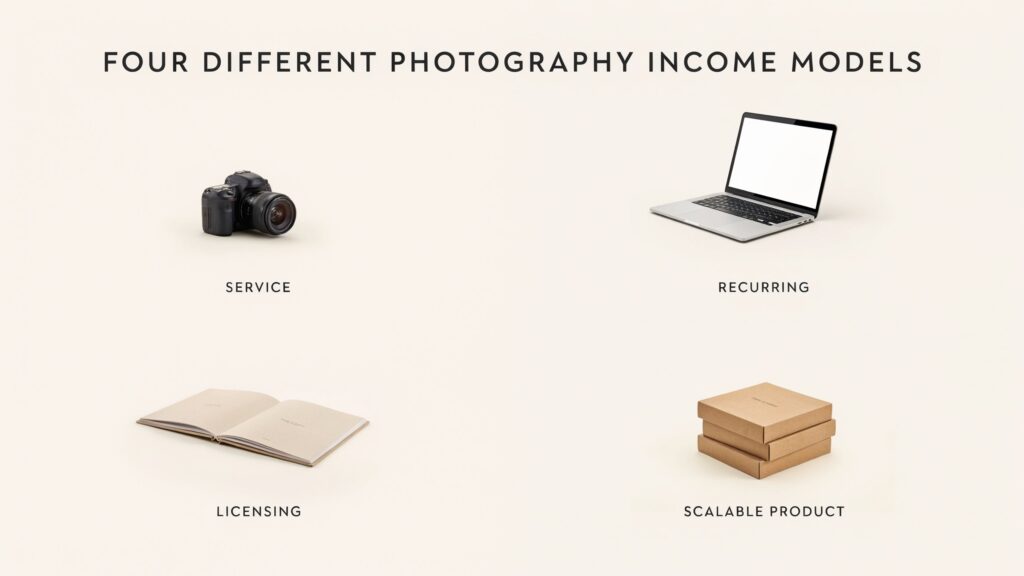
Photography income usually fits one of four models:
| Model | How payment happens | What must be repeated |
|---|---|---|
| Service income | A client pays for a shoot or custom deliverable. | Most production work is repeated for each client. |
| Recurring income | A client or member pays on a repeating schedule. | Ongoing service, access, support or new value. |
| Licensing income | A customer pays for permission to use an image under defined terms. | Rights management, discovery, administration and portfolio maintenance. |
| Scalable product income | Multiple buyers can purchase the same print or digital asset. | Marketing, fulfillment, support, updates, refunds and accounting. |
A stream can be both scalable and active. A course may be recorded once, but questions, platform changes and outdated lessons create new work. A print-on-demand order may be automated, but color problems and damaged deliveries still require attention.
The practical goal is not to remove work. It is to separate some revenue from one-to-one shooting hours while maintaining quality and trust.
Five scalable photography income models worth testing
Do not launch every idea at once. Choose the model that best matches assets you already control, a buyer you can reach and a problem you can verify.
1. Stock and marketplace licensing
You submit photographs or footage to a marketplace that handles customer discovery and licensing. This can suit commercially useful images with clean rights documentation and accurate metadata.
The work includes:
- Researching subjects buyers actually need.
- Planning commercially usable variations rather than uploading random favorites.
- Securing model or property releases when required.
- Editing to the marketplace’s technical standard.
- Writing accurate titles and keywords.
- Tracking acceptances, rejections, licenses and effective return.
A marketplace gives you distribution, not guaranteed demand. Shutterstock states that contributor earnings depend on a percentage of the customer’s license price and the contributor’s current earnings level. Adobe Stock currently publishes standard royalties of 33% for photos, vectors and illustrations and 35% for video, with additional rules for certain plans.[1][2]
Treat those as current platform rules, not forecasts. Read the contributor agreement before uploading, because terms, rates and eligibility can change.
2. Direct image licensing
Instead of relying only on a marketplace, you can license a focused collection directly to a business, publisher, nonprofit or agency.
A direct license should define:
- The exact images.
- The permitted media and purpose.
- Territory.
- Duration.
- Exclusivity or non-exclusivity.
- Editing and derivative-use permissions.
- Credit requirements, if any.
- Prohibited uses.
- Payment and renewal terms.
Direct licensing can offer more control, but it also puts negotiation, contracts, invoicing, file delivery and rights records on you. Do not describe a license as a sale of copyright unless you genuinely intend to transfer ownership and understand the consequence.
3. Prints and print-on-demand collections
A small, coherent print collection can be more testable than an enormous gallery. Build around a defined buyer or use case: local landscapes for hospitality spaces, quiet nature work for home offices, or regional architectural studies for businesses.
Before launch, order a proof. Check:
- Crop and aspect ratio.
- Color, contrast and paper response.
- Packaging and damage risk.
- Production time and delivery regions.
- Replacement and return process.
- Your rights to reproduce every visible person, artwork, property or trademark where applicable.
Print-on-demand reduces inventory, but it does not remove quality control, customer communication or margin pressure.
4. Digital photography products
Possible products include presets, LUTs, workflow checklists, shot-planning templates, location guides, portfolio-review worksheets or editing practice files.
A product is stronger when it solves a narrow, evidenced problem. “Cinematic preset pack” is vague. “A documented daylight portrait workflow for the camera profile and software versions you tested” is more specific and easier to support honestly.
For every digital product, state:
- Required software and compatible versions.
- Included files.
- Installation steps.
- Intended use and limitations.
- Personal or commercial usage rights.
- Whether updates are included.
- Support boundaries.
- Refund or cancellation terms permitted by your platform and local law.
If you use Etsy, its current policy says digital items must be made or designed by the seller; its official fee policy lists multiple charges that can affect the result, including listing, transaction, payment-processing, advertising and some country-specific fees.[3][4]
5. Education and audience-supported assets
A photographer can package proven knowledge into a guide, workshop recording, course, membership resource or carefully disclosed affiliate tutorial.
This is appropriate only when you can demonstrate the workflow and keep it current. Education is not automatically scalable: learner support, accessibility, moderation and software changes create continuing work. Advertising and affiliate revenue also depend on audience access and platform rules.
If you publish affiliate links, disclose the commercial relationship clearly and follow the rules that apply to your audience and location. If you build an email list, obtain valid consent where required, explain what subscribers will receive and provide an easy way to unsubscribe.
How to make passive income as a photographer: a seven-step asset system
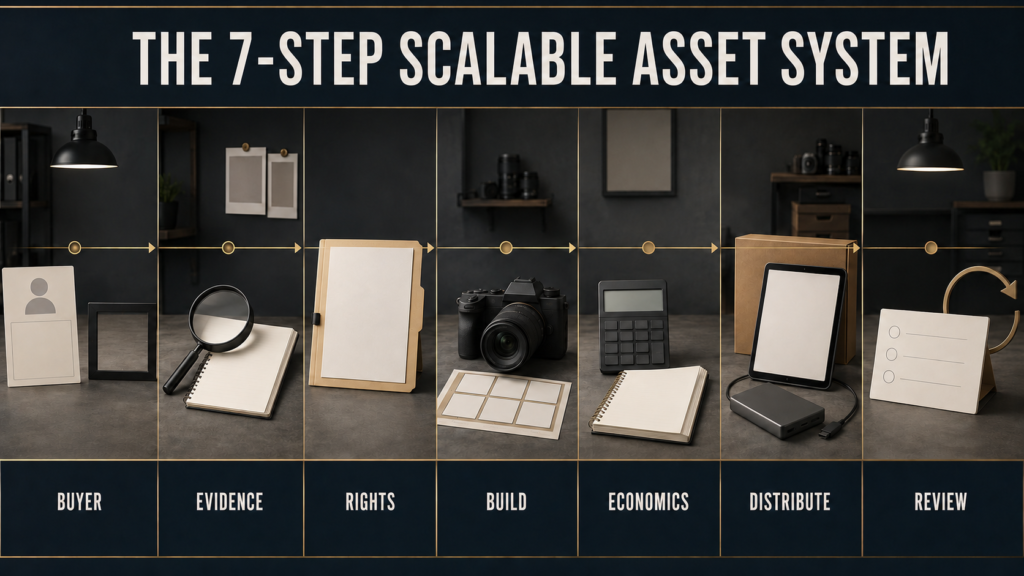
Step 1: Choose one buyer and one recurring need
Start with a real group you can describe:
- Independent restaurants needing seasonal food images.
- Local tourism operators needing regional visuals.
- Portrait photographers wanting a repeatable file-delivery checklist.
- Beginner editors using a particular application and camera profile.
- Interior designers sourcing calm, location-specific prints.
A broad audience such as “all photographers” makes demand difficult to verify. A specific buyer lets you observe language, constraints, purchasing context and alternatives.
Write one sentence:
I am testing a [type of asset] for [specific buyer] who needs [specific result or permission].
Step 2: Collect demand evidence before production
Do not treat search volume, likes or compliments as proof of a sale. Collect a small set of stronger signals:
- A buyer has already paid for an imperfect alternative.
- The same request appears in client emails or support questions.
- Buyers repeatedly ask for a specific subject, format or usage right.
- A relevant marketplace shows recent, credible customer activity.
- A buyer agrees to review a prototype or join a waitlist with clear consent.
Record the exact words buyers use. Those words should shape the asset and its explanation. Do not scrape personal information or add people to marketing lists without an appropriate legal basis or consent.
Step 3: Audit ownership, permissions and platform conflicts
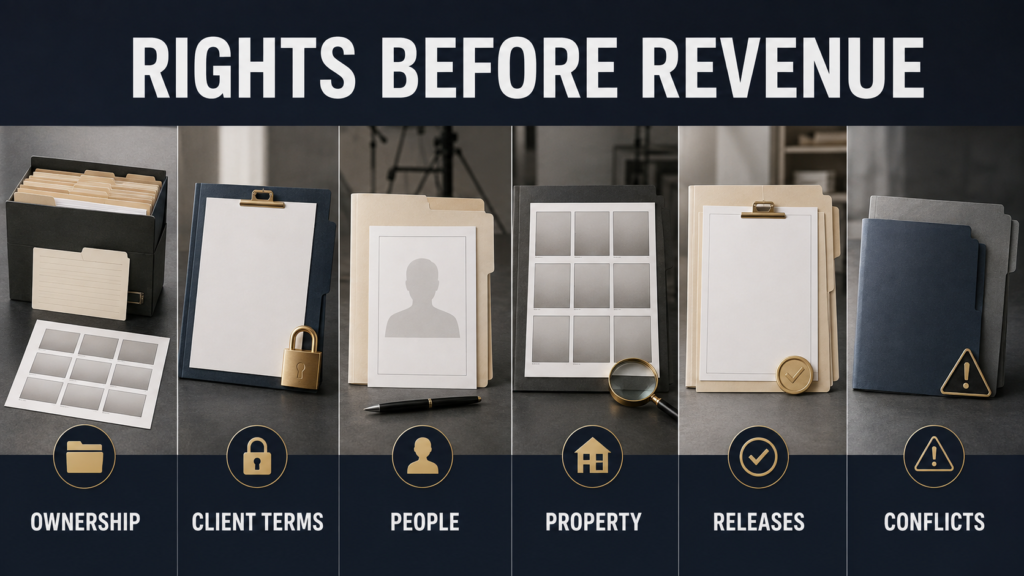
Before editing or uploading, create a rights record for every source asset.
Ask:
- Did I create the photograph or do I hold the necessary rights?
- Does a client agreement restrict reuse?
- Is any person identifiable?
- Is private property, artwork, branding or protected design prominent?
- Was the image created at an event or location with usage restrictions?
- Do I have the model or property releases required by the intended platform and use?
- Is an existing license exclusive?
- Does a marketplace agreement conflict with direct licensing elsewhere?
Release requirements are contextual, and rules differ by platform and jurisdiction. For example, Adobe Stock says a signed model release is required for recognizable people in commercial submissions, including some cases where a face is not visible.[5]
Use the current platform form and obtain local legal advice when the rights position is unclear. This article is not a substitute for legal review.
Step 4: Define the smallest credible asset
A minimum asset should be small enough to test, but complete enough to judge.
Examples:
- A tightly themed collection of rights-cleared images—not an unsorted archive.
- One print in two proven sizes—not twenty unproofed products.
- A focused preset set with before-and-after documentation—not dozens of near-duplicates.
- One concise guide that solves a single workflow problem—not a generic course.
- A direct-license preview collection for one business sector—not a mass email with unrelated images.
Write the deliverables, exclusions, compatibility, license, support and update policy before building. This prevents scope creep and makes customer feedback interpretable.
Step 5: Calculate the economics in your local currency
Revenue is not profit. Start with the full path from a customer payment to what remains after the asset’s costs.
Net asset result = collected revenue − refunds − platform and payment fees − direct costs − allocated operating overhead
Effective hourly return = net asset result ÷ total asset hours
Include research, shooting, editing, metadata, product setup, proof orders, support, updates, promotion, bookkeeping and rights administration in total hours.
For a platform, verify:
- Listing or upload fees.
- Transaction and payment-processing fees.
- Currency-conversion charges.
- Advertising fees.
- Withholding or reporting requirements.
- Minimum payout and supported countries.
- Refund, chargeback and reserve rules.
Do not copy a fee from an old comparison article. Link to the official page and record the date you checked it.
Step 6: Choose one distribution path
There are two broad routes:
Marketplace-led
A marketplace supplies search and transaction infrastructure, but controls discovery rules, fees and much of the customer experience.
Use this route when:
- The marketplace already serves your specific buyer.
- Its license or product format matches your asset.
- Its rules and effective margin are acceptable.
- You can tolerate platform dependency.
Owned-channel-led
Your website, email list or direct outreach gives you more control, but you must create demand, checkout, delivery, support and compliance systems.
Use this route when:
- You already reach the buyer.
- The asset needs a tailored license or explanation.
- You need customer relationships and first-party evidence.
- You can maintain privacy, tax, payment and support processes.
You can use both only when the agreements permit it. Never promise exclusivity to one buyer while distributing the same rights elsewhere.
Step 7: Launch a measured test and make a decision
Set a fixed test window and decide what evidence will count before launch.
Track:
- Qualified page visits or buyer conversations.
- Preview or sample requests.
- Checkout starts.
- Completed purchases or signed licenses.
- Refunds, rejections or support issues.
- Collected revenue.
- Total costs and hours.
- The objections and questions buyers repeat.
At the end, choose one action:
- Improve: the buyer need is credible, but the offer or presentation caused friction.
- Continue: the test produced enough evidence to justify another controlled cycle.
- Change: buyers want a different format, scope or license.
- Stop: demand, rights, margin or maintenance burden does not justify more work.
Stopping a weak asset is a useful result. It prevents a small experiment from becoming a large sunk cost.
Platform examples: compare rules, not income promises
The following examples show different distribution models. They are not a ranking or recommendation.
| Route | Useful for testing | Verify before using |
|---|---|---|
| Adobe Stock | Marketplace licensing of accepted photos, video and other supported assets. | Current royalty rules, content standards, releases, payment requirements and contributor agreement. |
| Shutterstock Contributor | Marketplace licensing with earnings tied to license price and contributor level. | Current earnings schedule, annual level rules, releases, accepted content and payout terms. |
| Etsy | Seller-designed digital products or physical products that meet Etsy’s creativity standards. | Eligibility, listing and transaction fees, payment processing, advertising, currency and local regulatory fees. |
| Gumroad | Direct digital product delivery and customer checkout. | Current fee page, payment availability, taxes handled by the platform, refunds and prohibited products. |
| Owned website | Direct licenses, focused products and first-party customer relationships. | Hosting, checkout, security, privacy, tax, accessibility, delivery, support and local consumer requirements. |
Platform policies are time-sensitive. Recheck the official pages immediately before publication and before making a business decision.
Scalable Asset Viability Scorecard
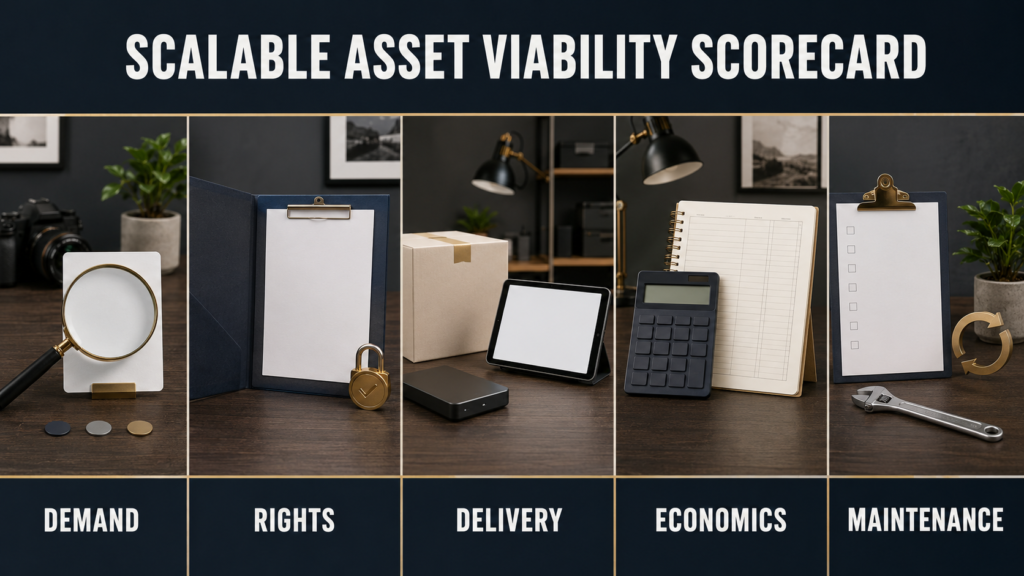
Score each factor from 0 to 2:
0: missing or contradicted.
1: partly supported or uncertain.
2: clear evidence and a controlled plan.
| Factor | Question | Score |
|---|---|---|
| Demand evidence | Can you point to a repeated, specific need from reachable buyers? | 0–2 |
| Rights control | Do you own or control every necessary right and release? | 0–2 |
| Repeatable delivery | Can another buyer receive the asset without rebuilding it? | 0–2 |
| Economic control | Can you identify fees, costs, refunds, overhead and hours? | 0–2 |
| Maintenance burden | Can you support and update the asset within a defined limit? | 0–2 |
Interpretation:
0–3: Do not build yet. Resolve rights or demand first.
4–6: Run only a very small prototype.
7–8: A controlled validation test may be reasonable.
9–10: The asset is test-ready, not income-guaranteed.
A high score does not predict sales. It means the test has fewer obvious structural weaknesses.
Licensing and release checklist
Before publishing, confirm:
- I recorded who created each source asset and when.
- I checked client agreements, employment terms and commissioned-work restrictions.
- I identified every recognizable person.
- I checked whether the intended commercial use requires a model release.
- I reviewed prominent private property, art, logos and protected designs.
- I matched the release to the intended platform and use.
- I defined media, purpose, territory and duration.
- I clearly marked the license as exclusive or non-exclusive.
- I checked conflicts with previous or marketplace licenses.
- I defined whether editing, cropping or derivative use is allowed.
- I stored signed documents and asset IDs securely.
- I set a renewal, expiry or review date where relevant.
- I obtained qualified local advice where the rights position is uncertain.
A 30-day photography asset validation experiment
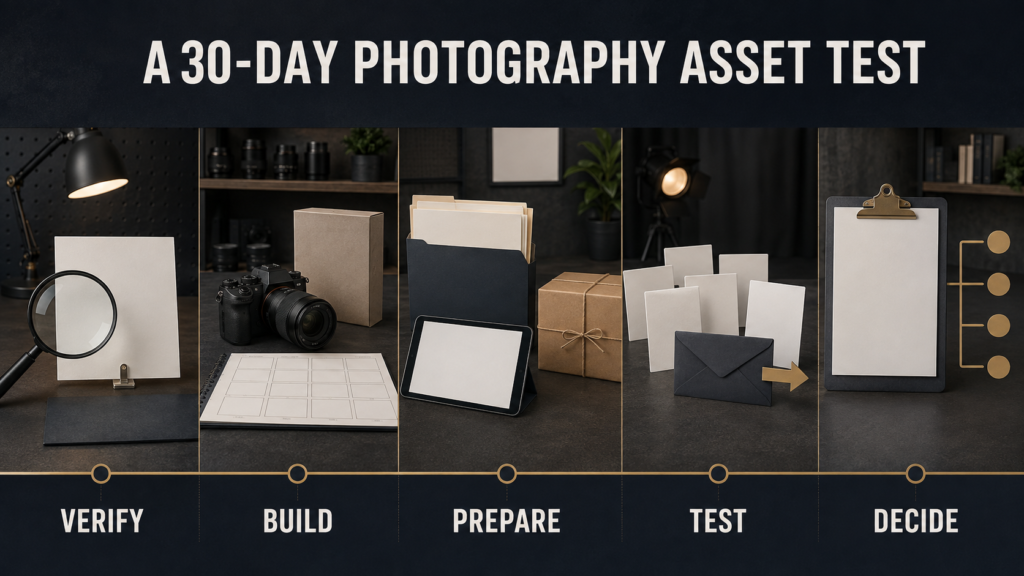
Days 1–5: Choose and verify
- Select one buyer and one problem.
- Collect at least three pieces of demand evidence.
- Choose one asset model.
- Complete the rights audit.
- Calculate a maximum test budget and time limit.
Days 6–10: Build the minimum asset
- Create the smallest credible version.
- Write the deliverables, exclusions and license.
- Test the files on the required software or device.
- Proof a physical product if applicable.
- Prepare an accessible preview.
Days 11–15: Prepare distribution
- Choose one primary sales or licensing path.
- Verify its current rules and fees.
- Write a factual product or licensing page.
- Configure payment, delivery, support and privacy steps.
- Test the complete buyer journey without publishing false reviews or scarcity.
Days 16–25: Put it in front of relevant buyers
- Publish or submit the asset.
- Share it only where the intended buyer is present.
- Use clear consent for any email collection.
- Record questions, objections and actions.
- Do not change five variables at once.
Days 26–30: Review evidence
- Record collected revenue, refunds, fees, direct costs and hours.
- Calculate the net asset result and effective hourly return.
- Identify the strongest and weakest evidence.
- Decide: continue, improve, change or stop.
This 30-day experiment validates a business assumption. It does not promise a sale, income level or completion timeline for a successful business.
Local-currency photography asset worksheet
Use one currency consistently for each test.
| Field | Your record |
|---|---|
| Specific buyer and need | |
| Asset and delivery format | |
| Rights and release status | |
| Distribution channel | |
| Collected revenue | |
| Refunds and chargebacks | |
| Platform and payment fees | |
| Direct production and fulfillment costs | |
| Allocated operating overhead | |
| Total asset hours | |
| Net asset result | |
| Effective hourly return | |
| Buyer evidence and repeated objections | |
| Decision and next test |
The maintenance work people leave out
A repeatable asset becomes unreliable when nobody owns its maintenance.
Create a simple schedule:
- Weekly during a test: check delivery failures, support requests and refunds.
- Monthly: reconcile platform statements, fees, tax records and licenses.
- Quarterly: review conversion, return, outdated files, broken links and policy changes.
- Annually: review rights records, product compatibility, pricing logic, privacy notices and whether the asset should remain available.
Retire an asset if you can no longer support it, verify its rights or explain its result honestly.
When to scale a photography asset
Scale only after a small test produces evidence you can explain.
Responsible scaling may include:
- Improving the best-performing asset instead of adding unrelated products.
- Creating variants for a verified use case.
- Translating or localizing after checking rights and support capacity.
- Adding a second distribution channel when agreements permit it.
- Automating delivery only after the manual path works.
- Building content around real buyer questions.
- Licensing a collection directly after validating the buyer sector.
Do not scale because one post received likes. Scale because buyers took meaningful actions and the economics still work after all costs and hours.
Common mistakes to avoid
Confusing popularity with purchase intent
High views can coexist with no viable buyer need. Track actions connected to the asset.
Uploading first and checking rights later
A technically excellent image can still be unsuitable for commercial licensing.
Comparing gross revenue with salary
Revenue before fees, costs, refunds, overhead, tax and time is not personal income.
Copying another creator’s product
Similarity can create intellectual-property, trust and positioning problems. Build from your own tested workflow and evidence.
Depending on one platform
A platform can change fees, discovery, eligibility or payout rules. Keep your source files, rights records, customer permissions and financial records organized.
Treating support as free
Support and updates are business hours. Include them in the worksheet.
FAQs
Is passive income for photographers really passive?
Usually not. Licensing and repeatable products can reduce one-to-one production for each sale, but research, rights management, distribution, support, updates and accounting remain active work.
What is the easiest passive income idea for a photographer?
There is no universally easiest model. The smallest responsible test is usually based on assets you already control, a buyer you can reach and a problem you have observed. Rights uncertainty can make an apparently easy idea unsuitable.
How much passive income can a photographer make?
There is no reliable universal amount. Results vary by buyer demand, rights, portfolio relevance, distribution, platform terms, costs, location and hours. Use collected results from your own test rather than an online income promise.
How long does photography passive income take to work?
There is no fixed timeline. A 30-day experiment can test evidence, delivery and economics; it cannot guarantee that the asset will become profitable within 30 days.
Are stock photos a good source of passive income?
Stock can be a valid licensing model when the work is commercially relevant, rights-cleared and accurately described. Marketplace acceptance or portfolio size does not guarantee licenses, and contributor terms affect the result.
Should I sell presets, LUTs or templates?
Only if you can demonstrate a specific result, document compatibility, define usage rights and support the files. Test one narrow product before creating a large catalog.
Do I need model releases for stock photography?
Requirements depend on the content, intended use, platform and jurisdiction. Recognizable people commonly require a signed release for commercial stock. Follow the current platform rules and obtain local advice when uncertain.
Can I sell the same image on several platforms?
Possibly, if every agreement and license is non-exclusive and permits it. Check existing contracts before distribution. An exclusive license can restrict later use elsewhere.
Should I use a marketplace or my own website?
A marketplace can provide discovery and transaction infrastructure; an owned site provides more control but more operational responsibility. Choose according to buyer access, agreement terms, costs and your ability to maintain the system.
Final takeaway
If you searched for how to make passive income as a photographer, the honest answer is to build one useful, rights-cleared asset and test whether a reachable buyer wants it.
Choose one model. Verify the need. Control the rights. Count every cost and hour. Use a small experiment. Then continue, improve, change or stop according to evidence.
The strongest scalable photography income system is not the one with the most products. It is the one you can explain, support and measure without promising a result you cannot guarantee.
Business-planning information only; not legal, tax or accounting advice.